Although I had hoped the Wattis Institute webinar Catching Ideas in Process: Jay DeFeo’s Photography would have focused more on the individual photographs of Jay DeFeo, I was nevertheless intrigued by the young artists explanations of how she continues to influence their work. With moderator Emily Markert panelists included: Corey Keller, Paul Mpagi Sepuya and Rayyane Tabet.
It was a surprise to learn about the 2500 postcards that DeFeo kept and used on the walls of her studio as images to inspire and in the compositional strategies of her photographs. In her life and in her work she was always keen to blur the line between documentation and art
As keepers of postcards, both the Rev and the Co-Rev have collections saved over many years and many travels.
When, on March 17, the mandate to shelter-in-place went into effect we thought, no problem we can do this… as artists we could not think of anything better than to just lock ourselves away in the studio.
As the mandate continued until April 7, then was extended again and again, by May the reality of the COVID-19 began to sink in. We joked about this time as our “Covid Vacation” but as many of our exhibition opportunities were cancelled, we started thinking about new ways to show and share our artwork.
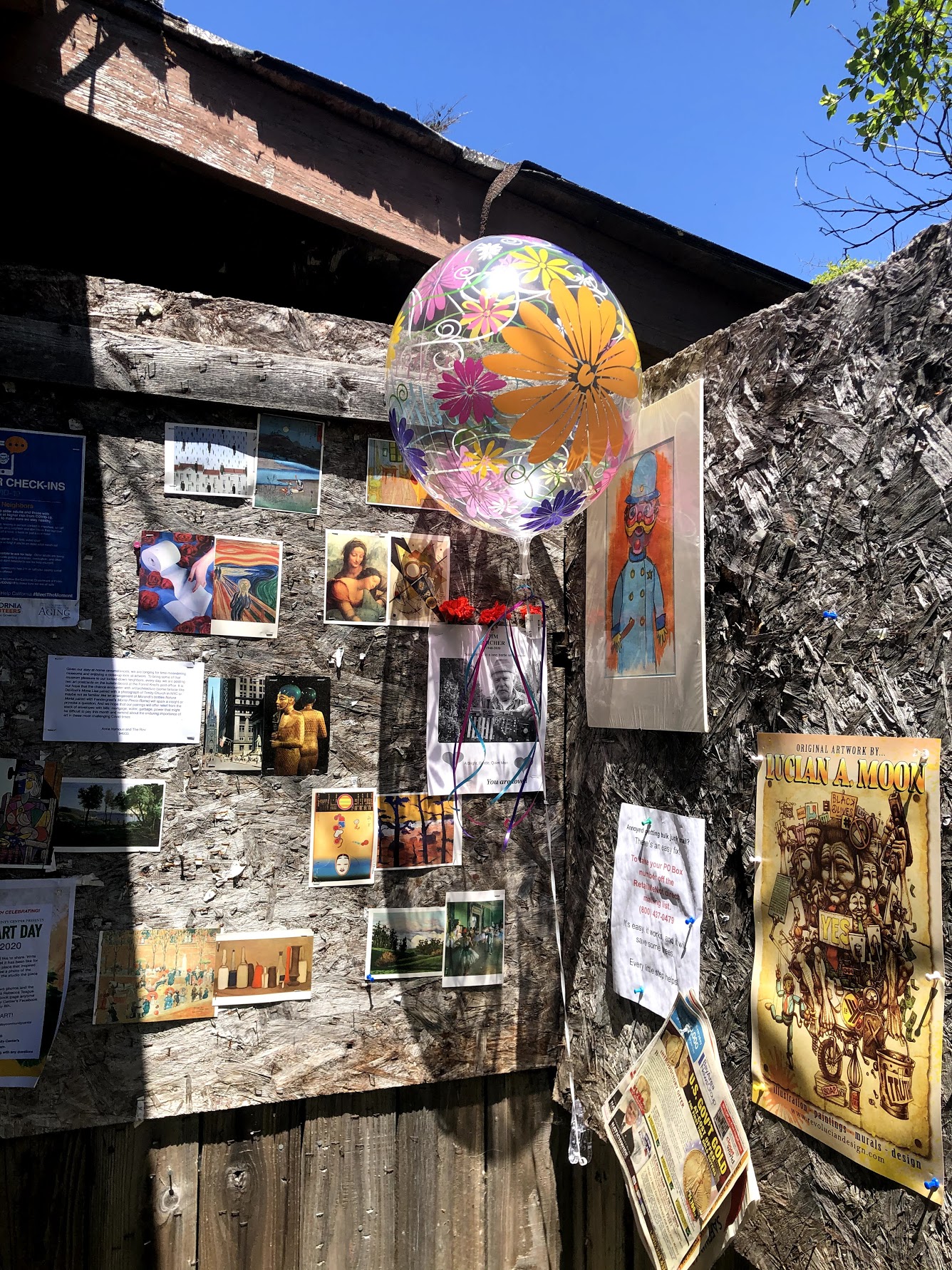
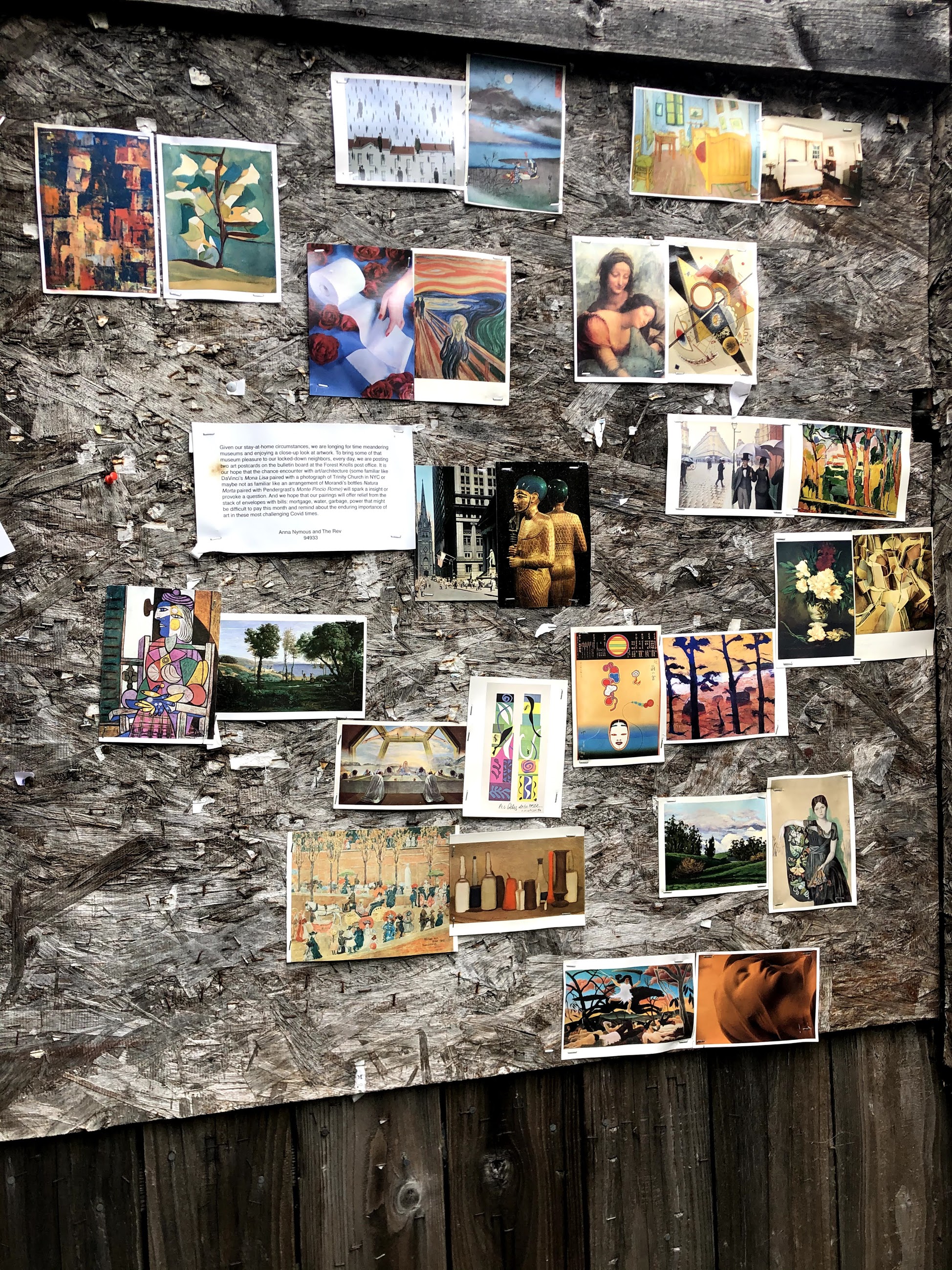
Which brings us to the postcards and the bulletin board at our Forest Knolls post office. Typically the bulletin board is covered with flyers and posters and community announcements. It’s the go-to place for what’s going on in the San Geronimo Valley and since everyone in FK goes there, we thought it would be the perfect place for an art exhibit.
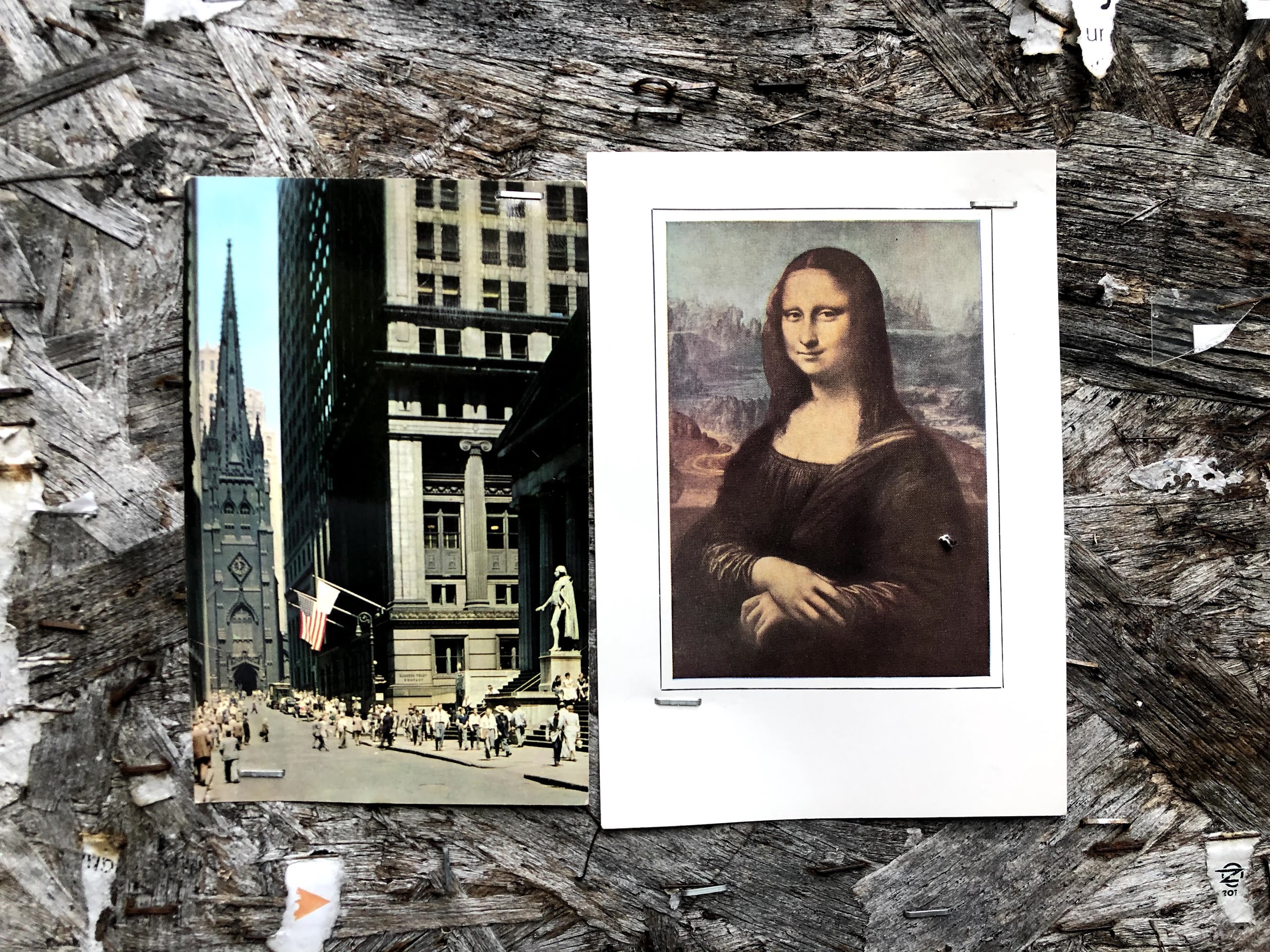
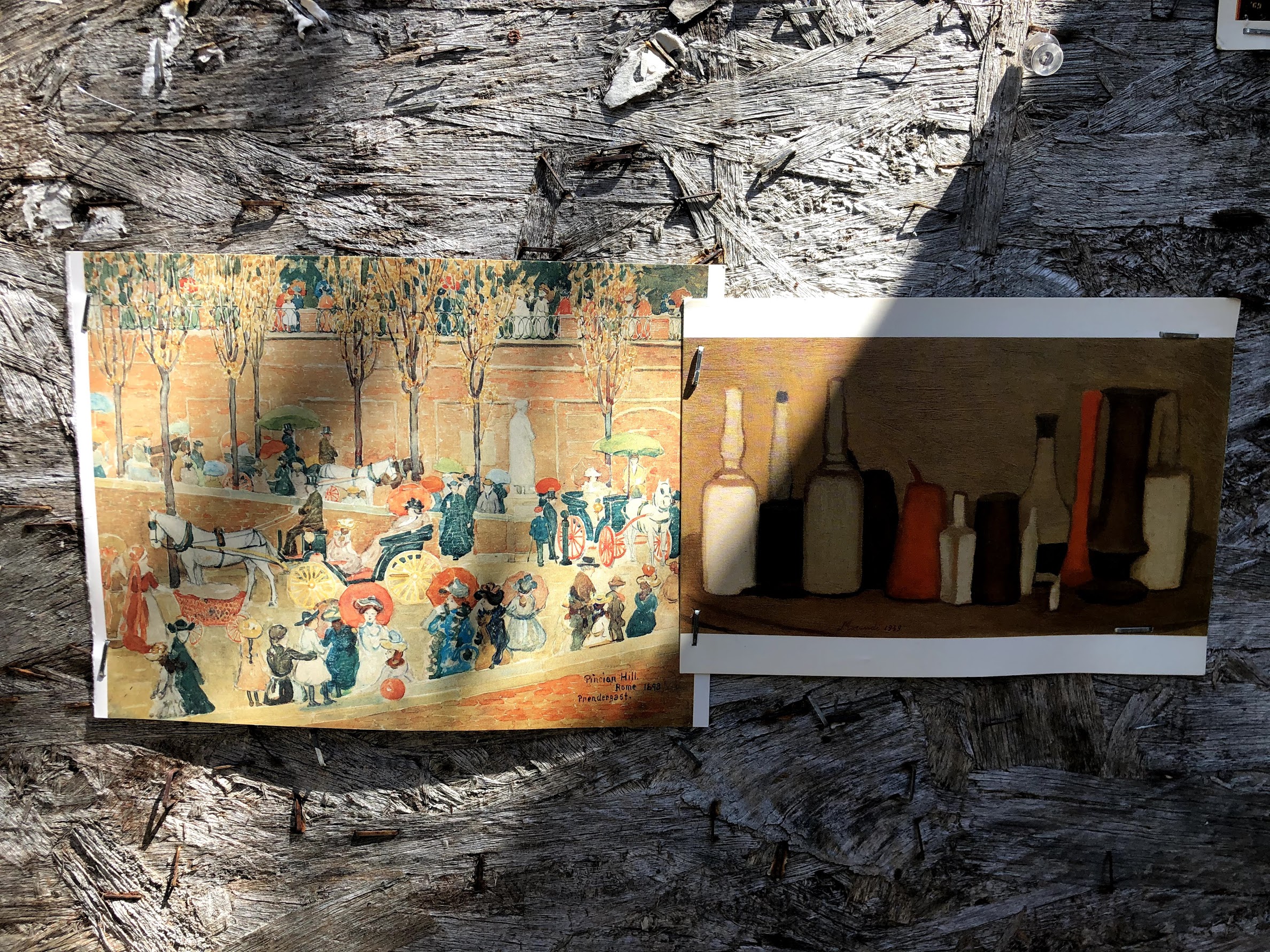
Given our stay-at-home circumstances, we were longing for time meandering museums and enjoying a close-up look at artwork. To bring some of that museum pleasure to our locked-down neighbors, every day, we posted two art postcards on the bulletin board. It is our hope that the chance encounter with art/architecture (some familiar like DaVinci’s Mona Lisa paired with a photograph of Trinity Church in NYC or maybe not as familiar like an arrangement of Morandi’s bottles Natura Morta paired with Pendergast’s Monte Pincio Rome) will spark a insight or provoke a question. And we hope that our pairings offer relief from the stack of envelopes with bills: mortgage, water, garbage, power that might be difficult to pay this month and remind about the enduring importance of art in these most challenging Covid times.
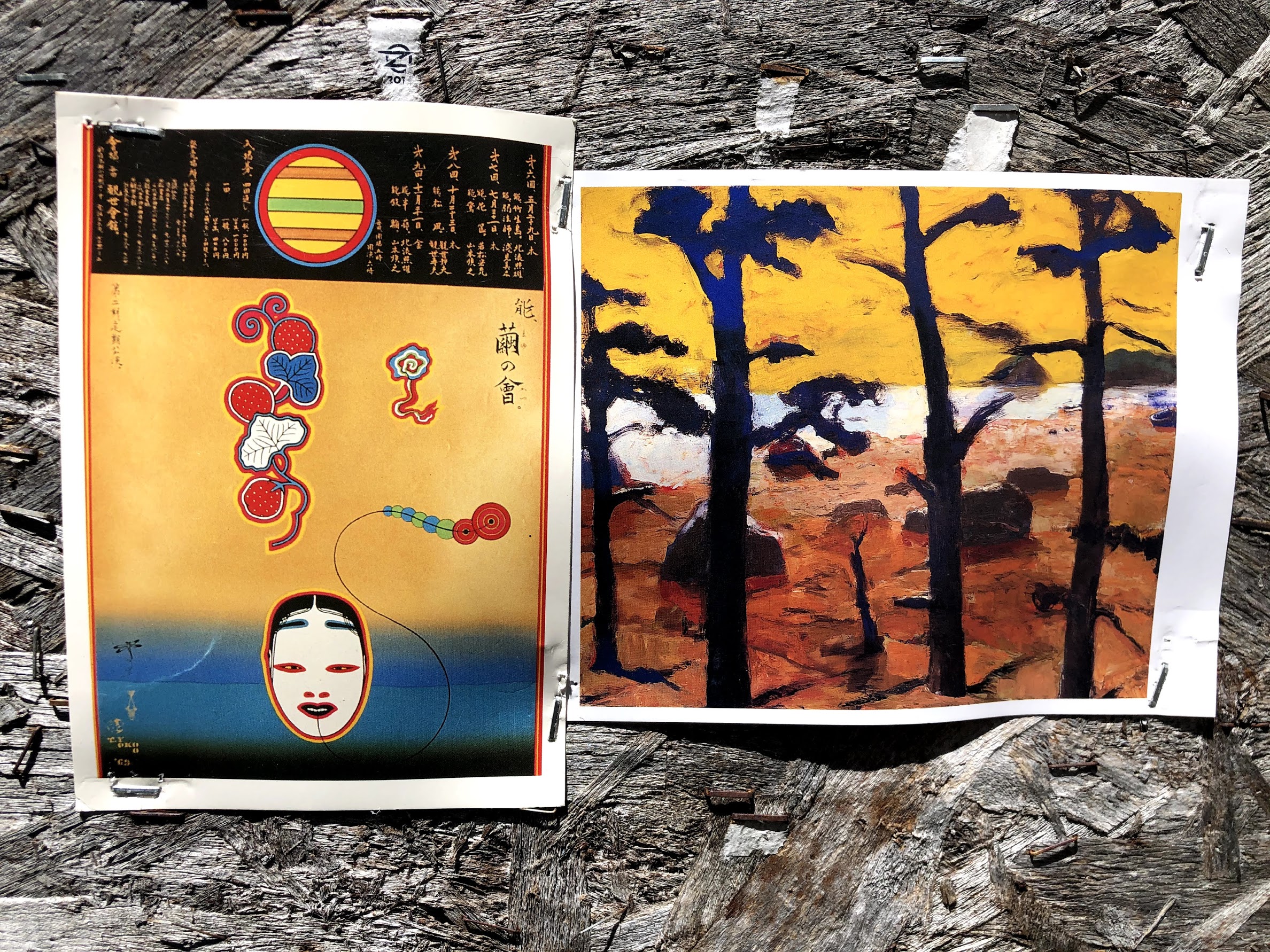
Every day, we shuffled the cards in the big basket of art cards then in an intuitive, spontaneous way selected two that called out. The call could be the color, the design, the texture. With these two, the band of yellow ochre was the unifying force. The contrast between the expressive brushstrokes of the Elmer Bishcoff’s Yellow Sky, 1967 (right) and the considered constructed design of the Tadanori Yokoo Poster for Noh Play 1969 (left) made for a perfect compare and contrast of texture.
Everyday a new pairing was posted and sometimes we had to put a replacement card for ones that were “stolen.” As our cards acculumlated, other people began to add to the gallery. Some bright red flowers were added to a memorial announcement. To celebrate a birthday, someone added a balloon. We sensed that there was community appreciation for our efforts. This corner of communication was alive. Not sure about the intended message of the drawing of a ruddy-cheeked British Bobby??? but the colors were bright.
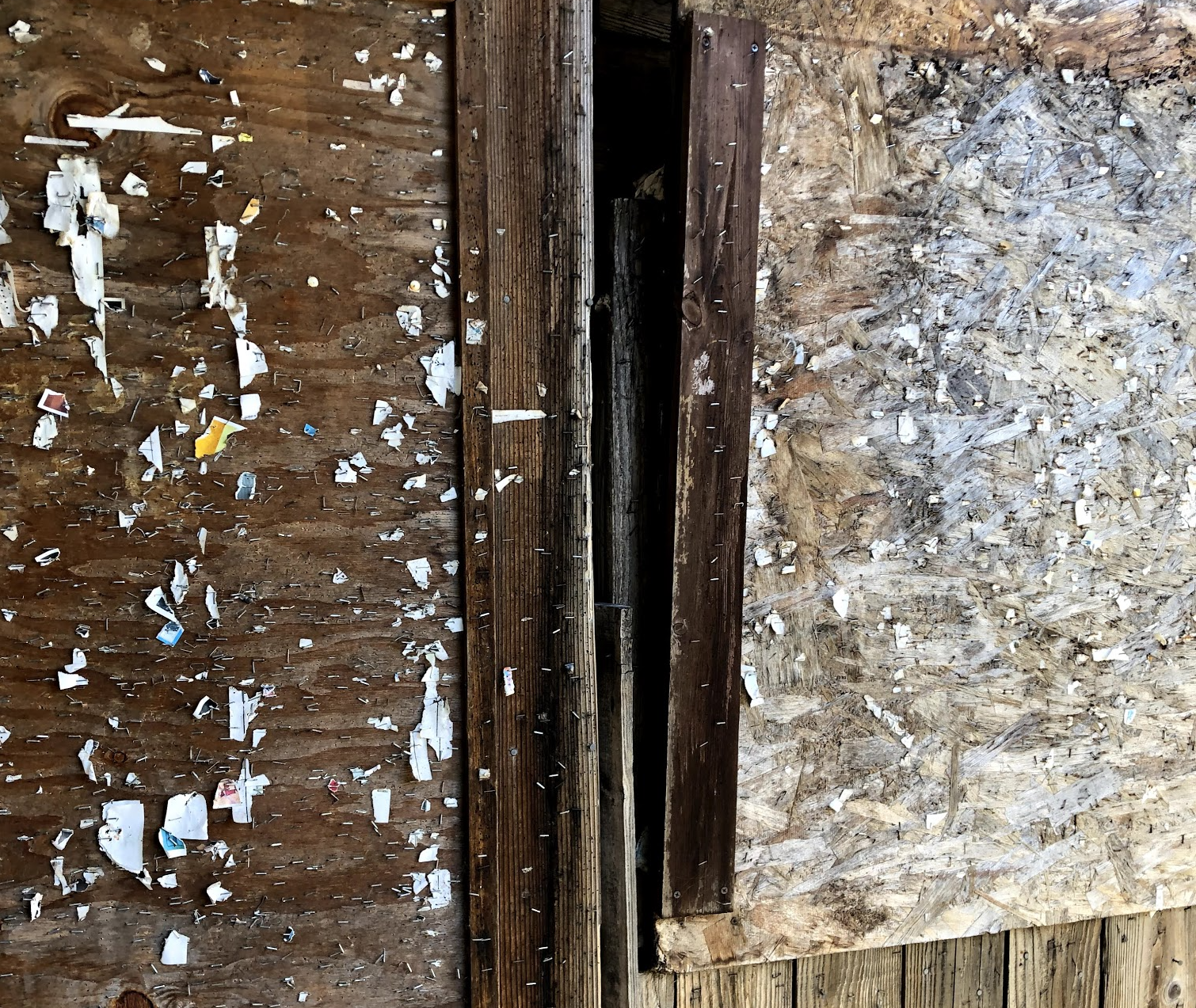
But one day, the bulletin boards was stripped bare. Empty!!! Not only were all of the postcards gone but all of the flyers, posters and community announcements were gone, too. The only trace was the tattered remnants of papers and the staples.
It was a shock. It remains a mystery about who or why everything was removed. The bulletin board remained bare for some time. Eventually a flyer appeared but soon, again, inexplicably the bulletin board was stripped bare. Is this a message about the gloom of isolation? Or the dispare of remaining imageless?
Not only in the pairings but in the overall presentation on the board showcased the absolute variety of the artistic response to landscape to portraiture to still life.
Disorderly, yes, in a cacophony across time and space Incongruities, yes, how do ____ and ____ go together?
We had hoped to evoke what Peter Schjeldahl describes as a “theraputic delirium “ as he roams the newly reopened Met and the 150 year anniversary show exhibition “Making the Met.”
We won’t be going to the Met anytime soon and our bulletin board gallery has been torn down but we still have an enormous basket full of postcards that will continue spark creative reveries and invite compares and contrasts.
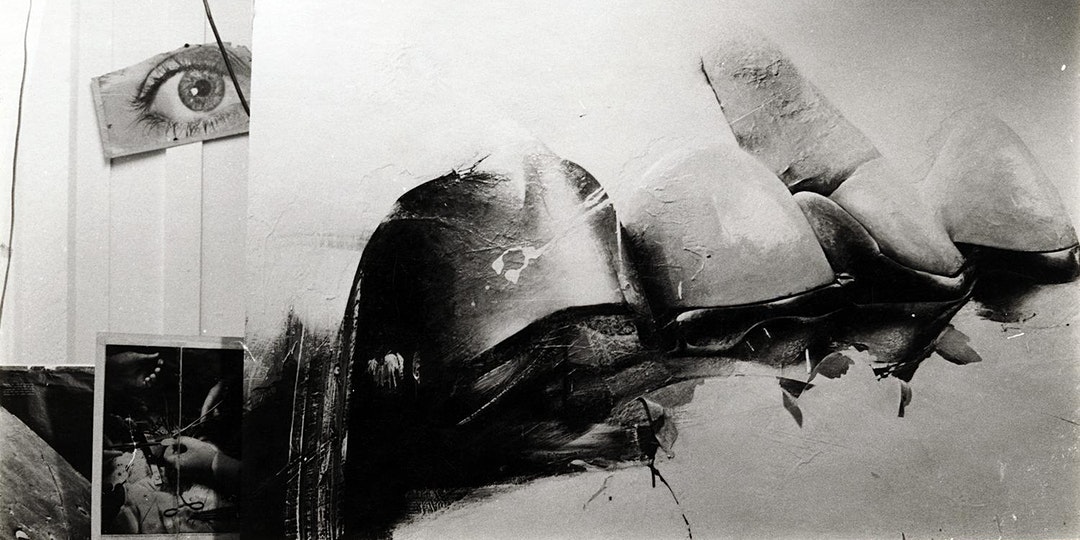
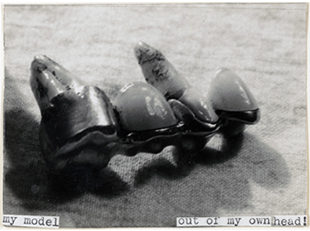
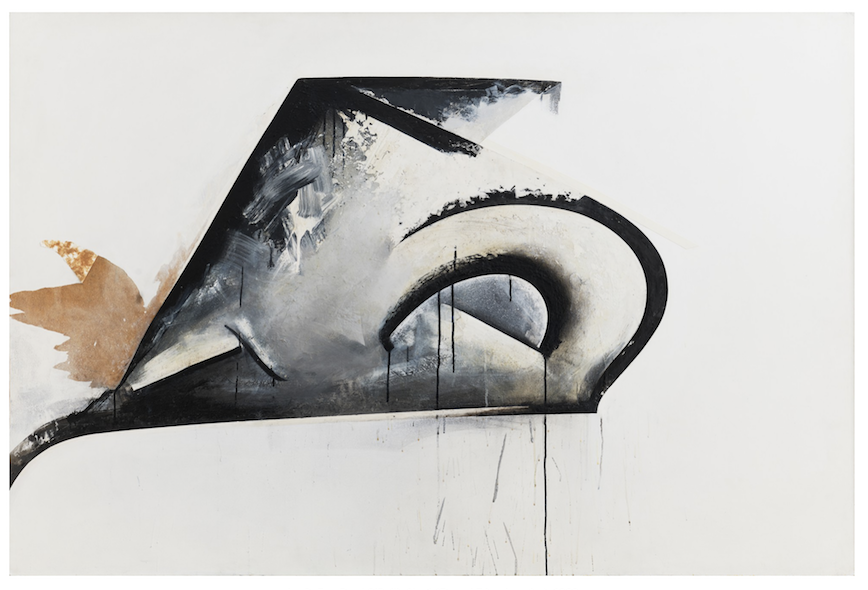
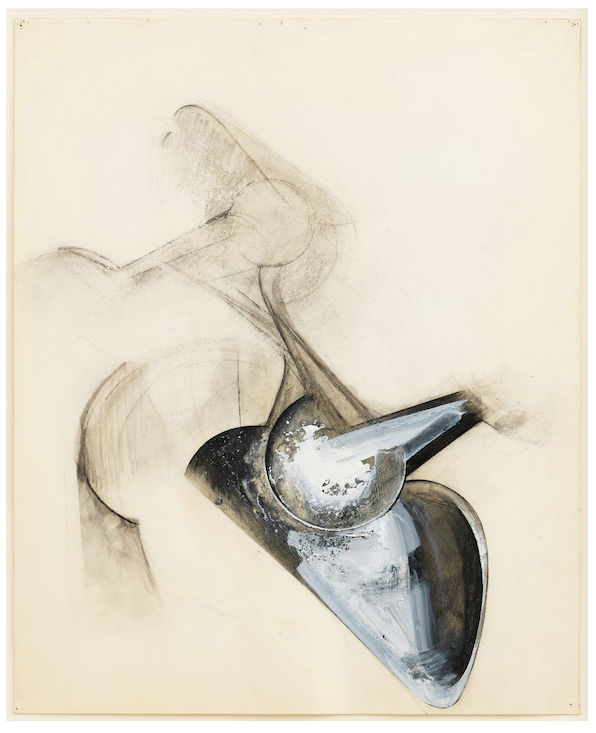
It’s been a big dental time around here. Since the Covid sheltering and restrictions, our routine care had been delayed and delayed. The Rev had a tooth that should have been pulled months ago and the Co-Rev was in need of replacing two old and broken crowns. This week all of that work got underway AND we came to understand DeFeo’s fascination with her tooth bridge. Her intimate photos of her model that came “out of her own head” were writ large in here painting Crescent Bridge 48″ x 66″.
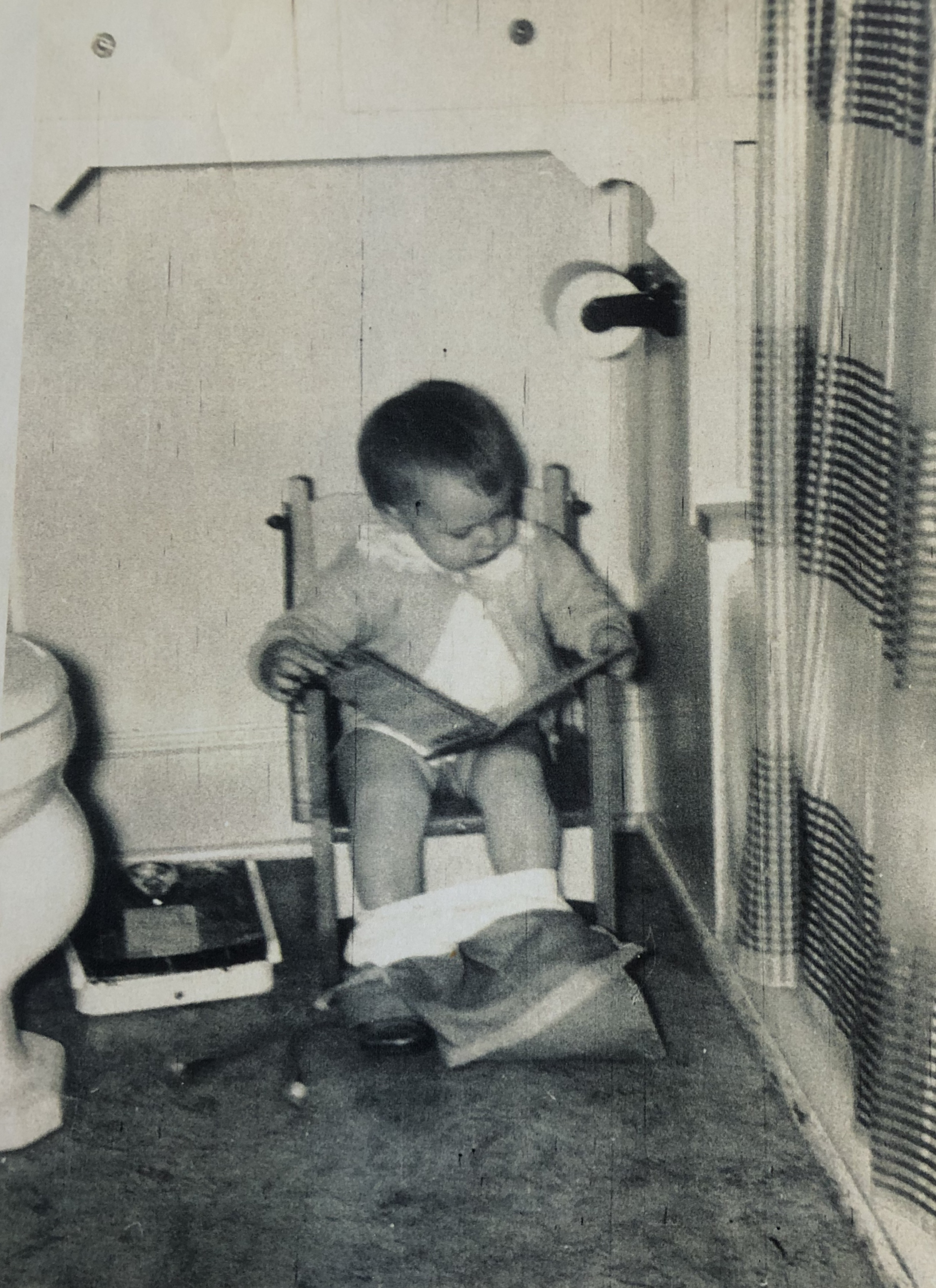
Since time immemorial, anytime, anywhere, I’ve loved to read. At age 2, I would turn the pages and marvel; transported by adventures beyond my limited knowledge of different cultures, histories, and societies.
At age 4, reading introduced me to life and people in real and fantastic ways. It ignited my imagination, taking me around the world. Without ever leaving home or school, I could walk in someone else shoes.
Fortunately, in first grade, my reading ability was encouraged by my teacher. When it was reading time, I sat with two others in the hallway with advanced story books while the rest of the class was still making their way through Dick and Jane —look, see, say. Like most every kid in the 1950’s I teethed on Dick and Jane and Spot the dog and Puff the cat. I was unaware of the sub-text of gender stereotypes because my mom and dad were living the 50’s dream. My mom stayed at home to take care of the children (me) and keep house, while the my dad went to work. I did not even know that racial and cultural diversity was missing because of the white middle class milieu I was growing up in. But, books offered possibilities beyond the constraints of my neighborhood.
Although my parents were proud of my academic prowess and encouraged my success, books were not much in evidence in our household. My mainstay was a set of World Book Encyclopedias where I poured over the illustrations of international costumes and customs, beckoning me to a wider world, showing me how different people lived and expressed themselves through their dress. My curiosity piqued, I longed to know more about everything.
This slideshow requires JavaScript.
In college and thereafter I was able to realize my need to live surrounded by books. Even when money was scarce, buying books came first. I would purchase some to read right away and some for the future. Sometimes, even if I felt was not ready for it, I would buy a book and put it under my pillow, hoping that as I slept the wisdom would seep in.
With Richard I met my match. His love of books is at least equal to mine….so over the years we have amassed bookshelves full, that spill over on to the floor and stack high on our bedside tables. We never seem to find the time to organize the hodgepodge on our shelves so they remain in a mishmash of genres with no sorting of fiction and non-fiction: science is mixed with travel adventure, poetry is interspersed with memoir. Try to find a book? HA! The good thing about this lack of a system is that one never knows what one might find.
Oh, if only, to live with an orderly arrangement like Chris Cobb’s rainbow display at Adobe Books, SF, 2004.
Buying books can be an addiction and now with online vendors of used books Thriftbooks and Abes Books it is especially easy to fuel. The obsession can easily be justified because the booksellers tout their environmental efforts that save millions of old books a year from the landfill.
To run with the gamut from potboilers and classics to paperbacks and rare fine artists books, with walls lined with stories is both challenge and comfort. In the night when I can’t sleep I’ll go to the bookshelf and slide out an old friend — reassured that the story is there again and again for me to enjoy. Grateful to the author who struggled to put their words to paper and grateful to the team of people: editors, illustrators, publishers who invested time and energy to bring those words to the public (me).
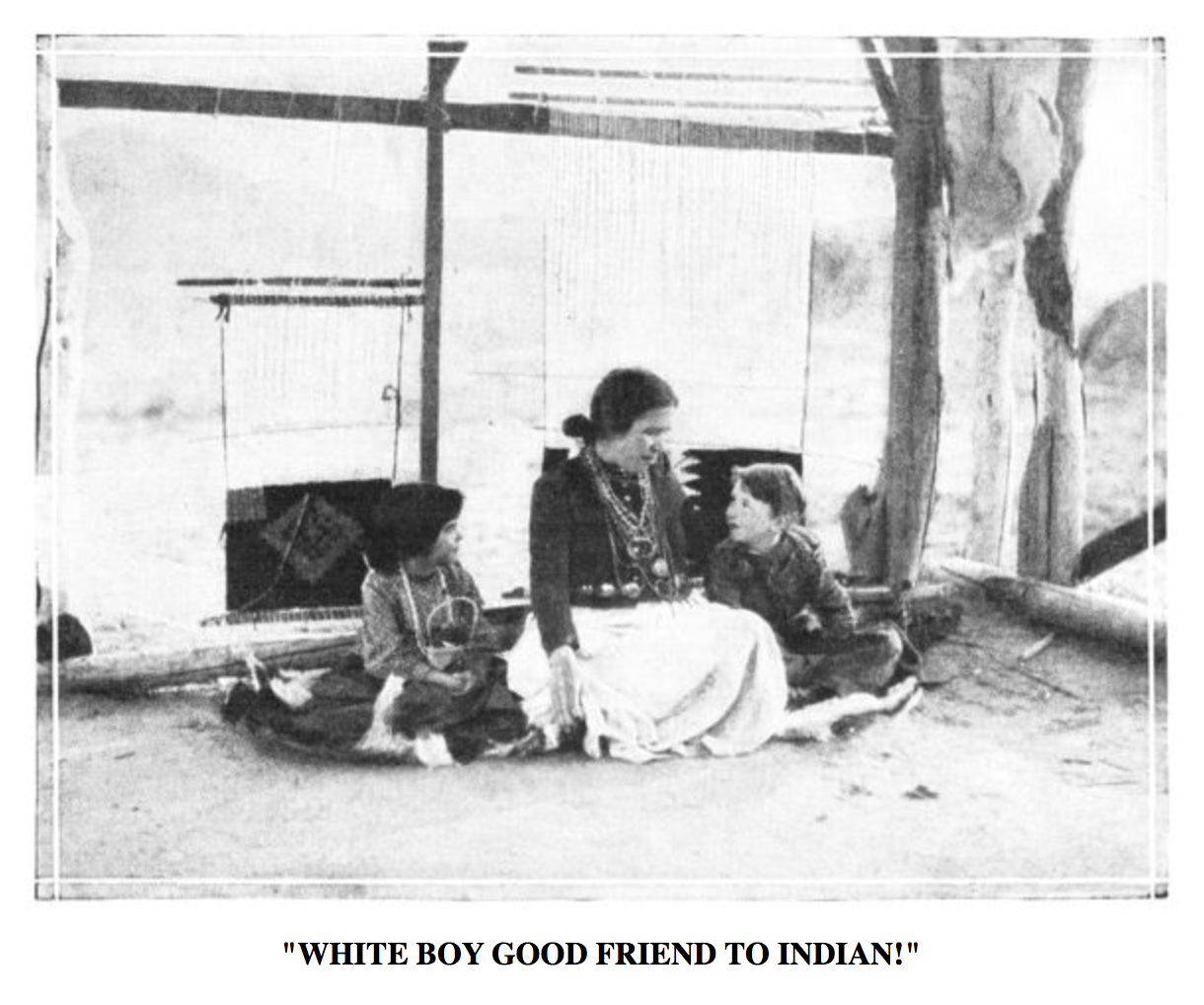
I have no recollection of when or how The Little Indian Weaver book came into my life some sixty or so years ago. But I can recall how much I enjoyed learning about people different from myself. Although today some of the descriptions might be passé even offensive, it remains a touching story about the friendship between a white boy and an Navaho Indian girl.
As a filmmaker and author Madeline Brandeis devoted herself to telling stories geared towards use in the elementary-school classroom illustrated with photographs she took on location with “Ref”, her trusty reflex camera. She produced 14 volumes in the popular series The Children of All Lands. After her untimely death in 1937 at the age of 39, four additional book were completed.
This dedication by Madeline Brandeis so beautifully expresses why I love this book: To every child of every land, Little sister, little brother, As in this book your lives unfold, May you learn to love each other.
All of Brandeis’s books can be borrowed from the Internet Archive. Project Gutenberg’s copy of The Little Indian Weaver. A film of The Little Indian Weaver in the Prelinger Archives
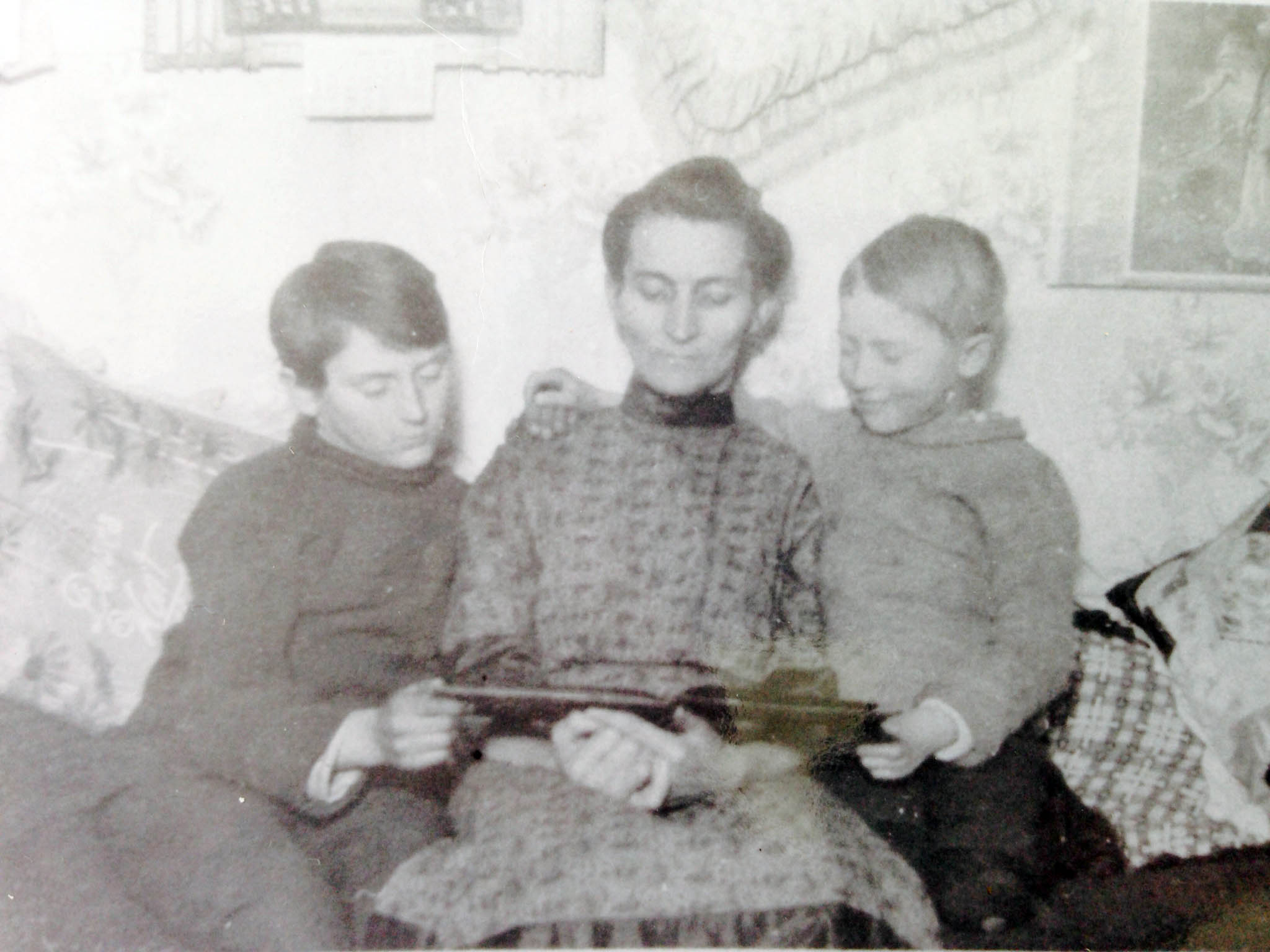
This photo is one of only three that I have of my Great Grandmother Mary. It is especially precious given how limited photography was in the 1910’s. Although Kodak’s Brownie was already popularizing photography, I can only surmise that in Montana taking a picture was still a rare occasion. That Mary wanted to stage a scene of her reading to her boys – my Grandfather, Edward 1901b (right) and his brother Art 1894b (left) is evidence of the value she placed on reading.
As a child my wildest imagination was stoked by the likes of Winnie the Pooh, Mole, Rat and Mr. Toad, Peter Pan and Tinker Bell, The Little Prince, Huck Finn, Dorothy from The Wizard of OZ plus the fairytales of Grimm and Andersen.
My roll call of characters continues to grow. A few of my classics include: Doc in John Steinbeck’s Cannery Row Stephen Dedalus, in James Joyce’s Portrait of the Artist as a Young Man The Father in Cormac McCarthy’s The Road Gregor Samsa in Franz Kafka’s The Metamorphosis
This week Mind Games bring us closer to the closest character in our play book — a deep look at the possibilities in being someone else and in experiencing someone else being you. As an exercise in role playing we will explore how empathy and understanding can be enhanced to benefit interpersonal relationships.
This can be played with a partner or while looking at yourself in a mirror.
Once again the time has flown and with this session we conclude our exploration of ——ART—SPIRIT—NOW——
Time does keep slippin’, slippin’, slippin’, slippin’ into the future but this week our Mind Games instructions have us traveling back from now, back to middle-age, back to young adulthood, back to adolescence, back to schooldays, back to childhood, back to infancy.
Back, back in our personal time, remembering experiences of our distant past. Stepping back so that instead of just slippin’ we can leap forward.
The guided mediation is also posted on the Compass Rose page.
Years ago, when I was keen on organizing my time, when I was big on goal setting, I realized that the emphasis on planning did not account for the play of serendipity. Often the unexpected was far better than the prod of goals. Now on New Years Eve, I look back to reflect, so to be better able to look to the future.
We are at a juncture of historical proportions, a tumultuous time when much is being called into question. Much that was not told is being added to the story or the story itself is being rewritten. Ask most people to name an artist and it most likely it will be a white male. Fortunately, that is changing. We began this series with Hilma Af Klint as our standard bearer for the revision of art history. Artists who were not given their due are being brought into the canon. YAY!!! Rosa Bonheur!!!
In the public sphere there is a concerted effort to include differences of gender and culture. LGTBQIA2S+ is the acronym for Lesbian, Gay, Bisexual, Transgender, Queer and/or Questioning, Intersex, Asexual, Two-Spirit, and the countless affirmative ways in which people choose to self-identify.
As an older white female it is a bit confounding (and heartening) as letters and numbers are added but I agree, let’s make sure that all varieties of human identity and sexuality are in the mix. Standing in the grocery line, I often feel almost invisible. My graying hair and wrinkled face, my cardigan sweater and white socks with sensible shoes, belie my spirited internal creative life. This camouflage of normality is its own masquerade, giving me a certain freedom…since nobody notices, I am free to think and do what I want. And, before the 6′ distance requirement, it was great for taking full advantange of my curiousity — listening in on the conversations of others AKA “eavesdropping.”
We are taking a step back to take a leap forward. Buildings are being renamed, statues are being removed, forbears are being acknowledged.
The Portland Art Museum (Oregon) recognizes and honors the Indigenous peoples of this region on whose ancestral lands the museum now stands. These include the Willamette Tumwater, Clackamas, Kathlemet, Molalla, Multnomah and Watlala Chinook Peoples and the Tualatin Kalapuya who today are part of the Confederated Tribes of Grand Ronde, and many other Native communities who made their homes along the Columbia River. We also want to recognize that Portland today is a community of many diverse Native peoples who continue to live and work here. We respectfully acknowledge and honor all Indigenous communities—past, present, future—and are grateful for their ongoing and vibrant presence.
Chafing at my staid life as a teenager growing up in Sacramento, I longed for a wider and deeper world and North Beach was where I thought I would find it. During my high school years I made several trips alone via bus to San Francisco. I would walk the distance from the Greyhound terminal to North Beach where, hoping for a sighting of the likes of Ferlinghetti or maybe catching a glimpse of a beatnik donning a black turtleneck and a black beret, I would be, at least for a moment, at the epicenter of hip and cool.
At City Lights I would buy a book (the image-poems of Kenneth Patchen were a fave) then head for Caffe Trieste where I would linger all afternoon sipping cappuccinos and, with as much existential angst as I could muster, would sketch in my journal.
Although I had always wanted to experience a poetry reading in North Beach, my parents expected me home before dark. So after grand visions of myself as an artist were fueled with caffeine, I would troop back to the Greyhound and bus back home.
From my fascination with the Beat Era, I knew the name Jay Defeo and was familiar with her monumental The Rose that took her eight years to complete (’58-’66). It was exhibited at the Pasadena Museum in 1969 then languished for 25 years before it was conserved and is now on view at the Whitney. She had some notoriety back in the day…and with a name like Jay, it was possible to confuse her gender identification. After completeing The Rose she had several years hiatus and there were several years that she did not work for lack of studio space. She eventually continued to express independence in her art, photography, life and influence students at Mills College.
Tony Bravo’s review (10/16/20) in the SF Chroniclebrought DeFeo back to mind and led me to the Gagosian website devoted to the exhibition Transcending Definition that presents a stunning slidehow of installation views and many of the mixed-media works in the exhibit.
To say that the revelations of these artworks “knocked my socks off” might be an understatement.
Serious scholarship considering DeFeo’s oeuvre continues to grow. In this conversation Natalie Dupecher from The Menil Collection and Leah Levy from The Jay DeFeo Foundation discuss the role that photography played in her experimental mixed-media works.
Let’s, one more time, take a step back to take a leap forward.
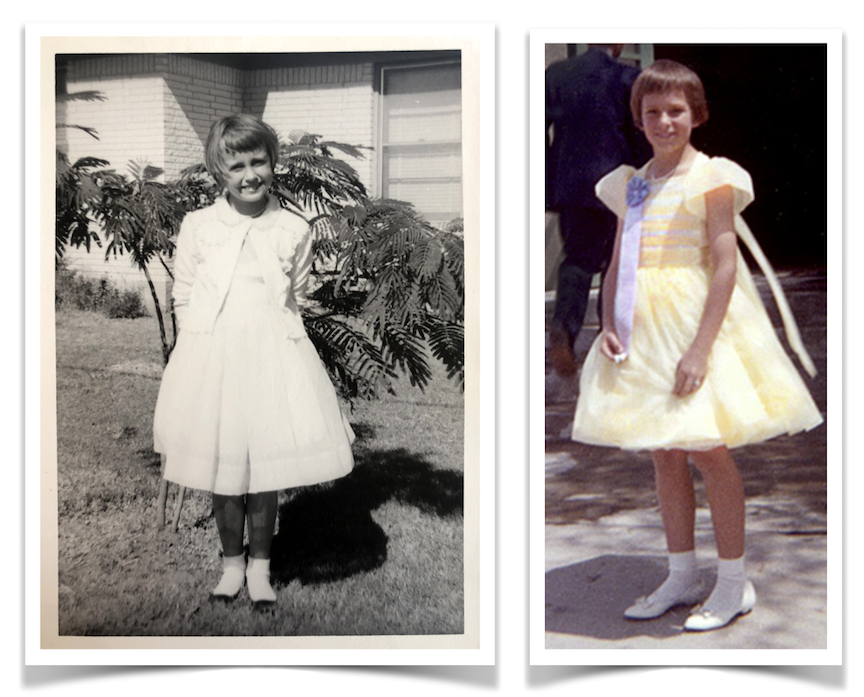
I was thrilled to learn about our Coleus connection. Now, I’m astonished to have found yet another connection in our dresses. Here we are… posing questions about: Where did we come from? and where we are going?
The Secret Life of Plants when published in 1973 was considered kooky, new-agey, pseudo-science and granted, many of the theories that were considered to be fringe have been debunked. Nevertheless, the book still stands as place marker in my early gardening education and did influence my back-to-the-land years.
It was filled with ideas that then seemed crazy, like playing music to encourage growth. Today Granddaughter Clementine insists that corn grows better with rock and roll. Scientists consider that it might not be the music per se but the vibrations that stimulate movement in plant cells that produces growth. Either way, who doesn’t enjoy a little Roll Over Beethoven while turning and tilling the soil.
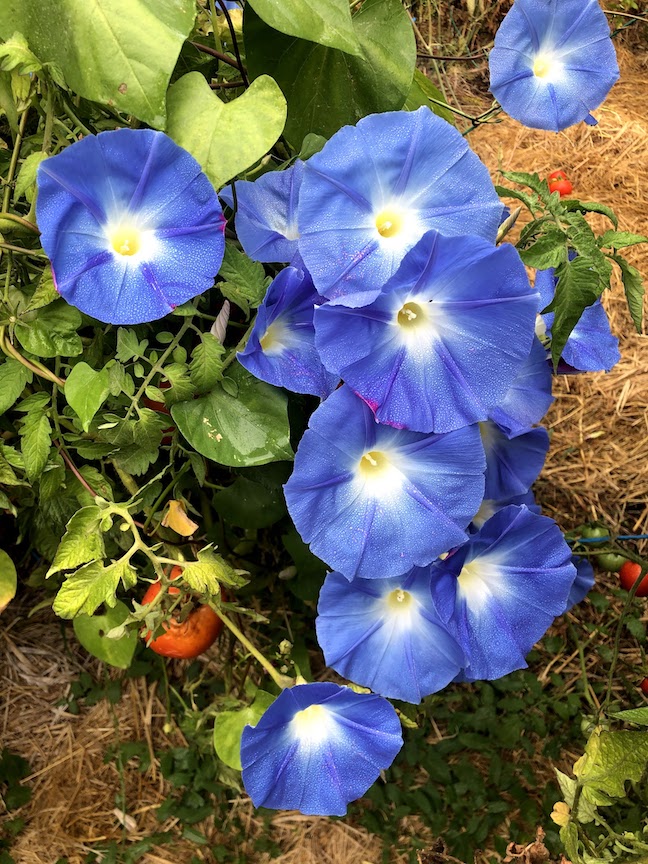
As tender, as appreciator, as consumer, I know first hand the beneficial effects of plants. Learning as I go along, gardening is a process not a product. I have learned to be attuned to plants need for water/nutrients and watch as they move towards the light of the sun. Gardening is a story of triumph and heartbreak. I’ve accidentally killed a few plants and the gophers have done plenty to aide in their demise. Some have suffered by being planted in the wrong place. Some have just failed to thrive. Try as I may, rhubarb has never done well. But, I’m champion with tomatoes and potatoes and spectacular with snapdragons and morning glories.
It was Coleus that first captured my growing imagination. Back in the 70’s during the houseplant heyday, they were the easy success plant for budding green thumbs. So easy to grow, cuttings easy to root. Rows of Mason jars on the kitchen window sill —jars with murky water thick with leggy tendrils of roots, spooky, like vampire squid specimens in a natural history museum. Those abundant roots made for robust plants. Coveted and shared, Coleus foliage with unusual (psychedelic!!!) patterns and color markings was the hippy plant par excellence.
Mind Games this week offers a meditation on finding one’s plant spirit guide. It can be listened to inside then once you have taken the instructions to heart, and now that the smoke has cleared, you can go anywhere, even outside in the yard to commune, to experience.
The guided mediation is also posted on the Compass Rose page.
WAIT!!!WAIT!!!WAIT!!!
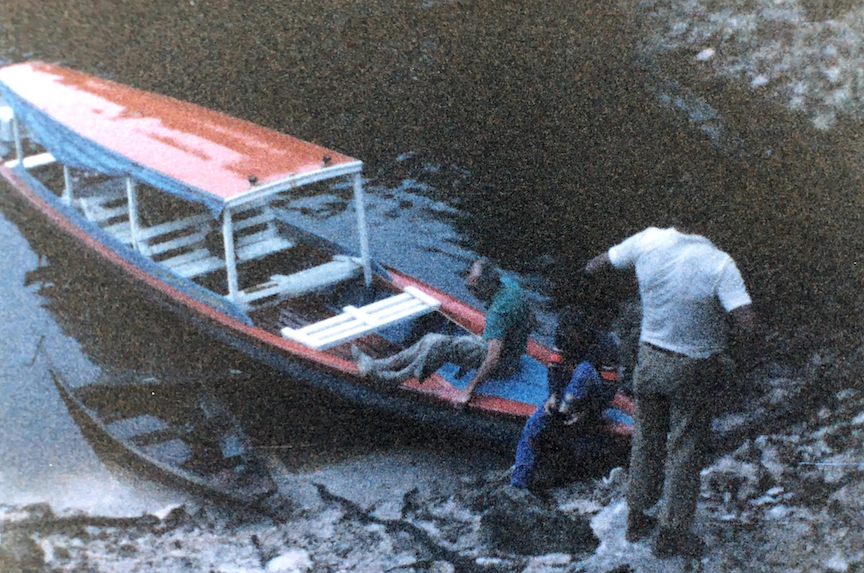
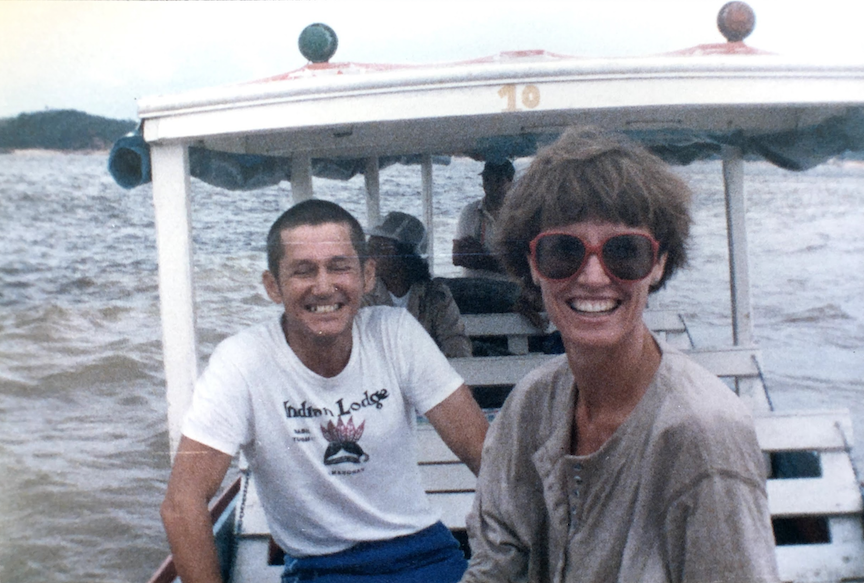
On Tuesday when the AMAZON PRIME DAY banner flashed across my computer screen, the word AMAZON sparked a distant memory of my trip through the Amazon rainforest where I was shown the healing plants/spirit guides of the indigenous peoples of Brazil. Digging deep through my boxes of memorabilia, I retrieved my photo album of that journey. The photos were taken with a compact Instamatic camera. Although, the negatives are grainy and the prints are not very sharp, they serve to illustrate…
AMAZON — worlds largest online retailer for shopping is working its way into every aspect of our lives…including subscription services, movies and media. On AMAZON PRIME DAY we are enticed pummeled with bargains on consumer electronics with the best tech deals of the year.
AMAZON — worlds largest river as a measured by volume of water and is disputed (vying with the Nile) as the longest river in the world. Any way you measure it, it’s big. The complex ecosystem is a massive intricate water way that encompasses hundreds of tributaries. Spanish soldier Francisco de Orellana was the first European to explore the length of the river in 1541. After encountering and engaging in battles with female warriors who reminded him of the Amazons in Greek mythology, he named it el Rio Amazonas.
In 1988, after attending a conference in Rio, with my companion Thomas Hanna, our flight back home had a scheduled stop-over in Manaus, capital of the state of Amazonas and the departure point for trips on the river and into the rainforest.
There are river trips aplenty with folded napkin luxury liners but wanting a more authentic experience, instead of booking ahead, we decided to just jump off (into the unknown) and let serendipity guide our way.
As we disembarked the plane there was a crowd of eager travel agents with slick signs touting their once-in-a-lifetime delux excursions down the mightiest river on the planet … see live piranha and live to tell the tale!!!
Away from the clamor stood a lone woman with a simple cardboard sign——river trips. Quiet, sincere, just our style. She took us to her card table “office” where we signed up.
Next day at the dock — when we saw our “boat” open-to-everything, we knew we had gotten it right. Modest, indeed, with plenty of fresh air and easy access to the water. Just our group — Tom, me, the boat captain, the cook, and our interpreter/guide. All aboard!!!
From Manaus, our guide wanted to make sure saw all the sights, including the popular tourist destination — the phenomena called the Meeting of the Waters, where the dark inky waters of the Negro River meet the pale ochre waters of the Solimões River, flowing side by side for miles without mixing. Top: dark water from the Rio Negro Bottom: sandy-colored water from the Rio Solimões We had no idea where we were going or where we would end up. Were we fool-hardy to trust these complete strangers who were taking us by boat to who knows where? For hours we traveled down river until we finally reached a village, where we were graciously welcomed by the “committee.” It’s difficult to see that the building is up on stilts. During the rainy season, October to March, the area is flooded so the kids travel to school via canoe.
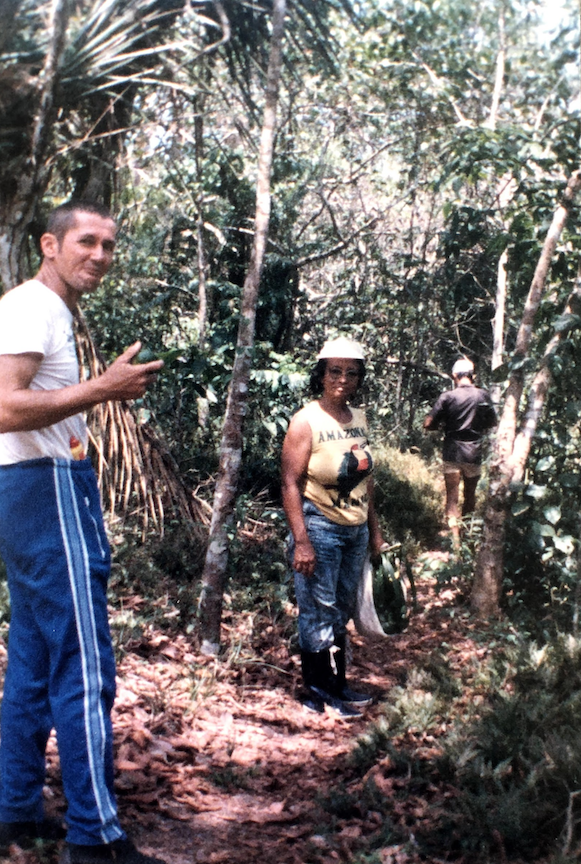
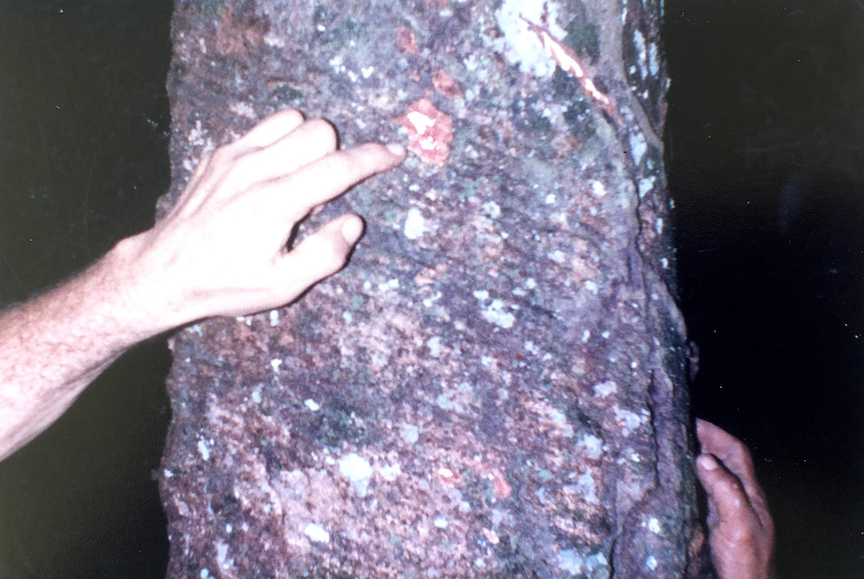
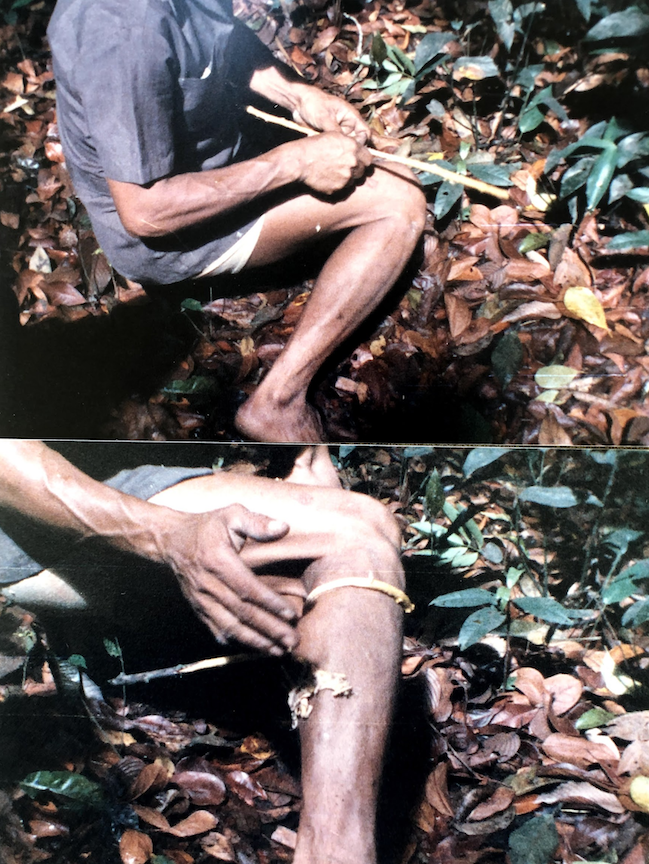
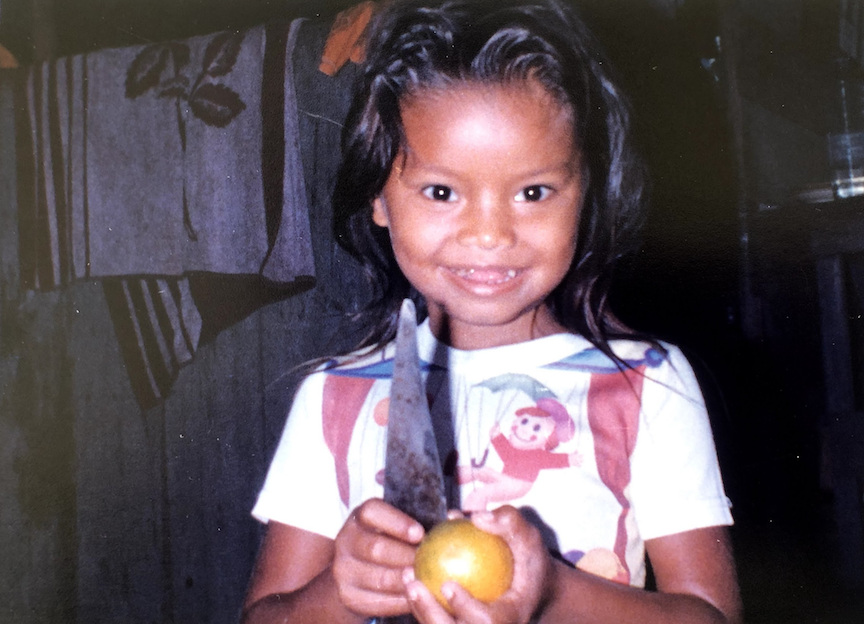
Our guide learned of our interest in plants and medicine so we were accompanied by the village Shaman, expert botanist, on a hike through the deep jungle who all along the way pointed out the beneficial plants. With more than 80,000 plant species, the rain forest is oft described as the world’s largest medicine cabinet with the benefits of thousands of plants yet to be discovered.Indigenous healers have known for centuries about the medical properties of barks and leaves. Knowledge about nature’s gifts has been passed on generation to generation. Arguments about the fate of the Affordable Care Act and the cost of drugs should include discussion about global warming, fires and the fate of the rainforest. Cures for debilitating diseases and the future health and welfare of humanity might just be found in the bark of this tree.When there are no ambulances or hospitals nearby, what about wound care? All is not lost. A tourniquet using strips of bark can save a life.We’ve all heard that “laughter is the best medicine” and science confirms that a good laugh does wonders for body and mind. So how about a toothy smile (with a few teeth gone) from a girl who lives in the Amazon rainforest? Her smile will certainly cure anything that ails you.
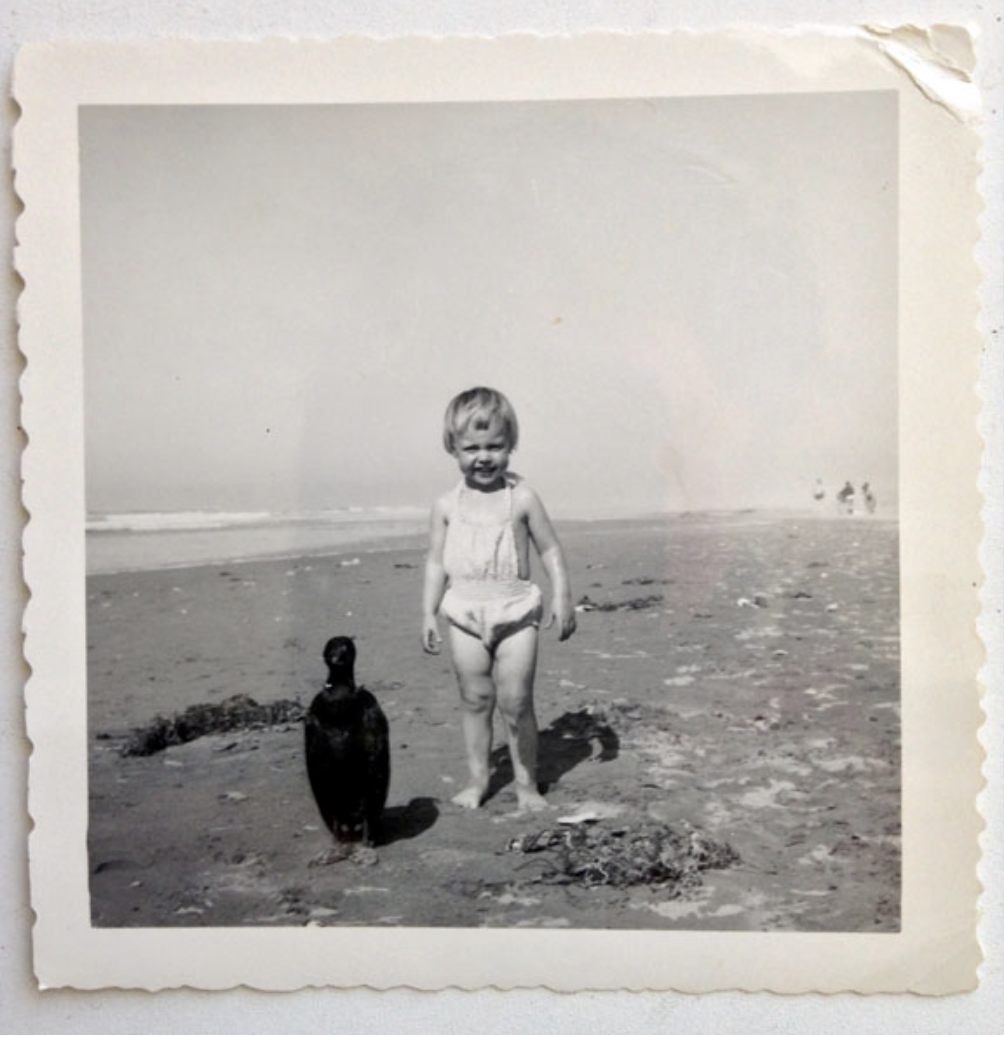
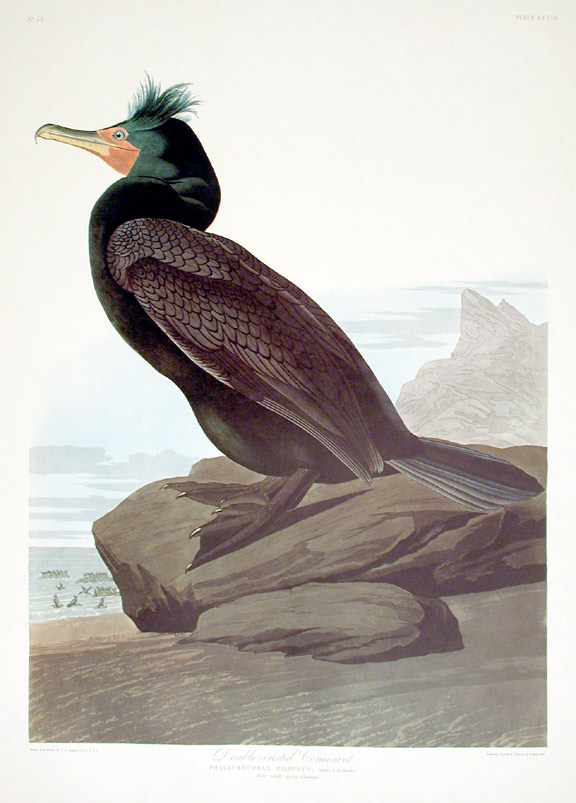
1952. Seaside, Oregon. It was a time when pleasures were simple— a sunny day, a Cormorant, me — two years old and already bird friendly.
Next up in the Mind Games book is a metamorphosis “game’ about finding and communing and becoming one with ones animal spirit. The guided instructions are linked HERE and posted on the Compass Rosepage.
In the 90’s I served on the Access Committee for the Fine Arts Museums of San Francisco. In that capacity, in conjunction with exhibitions, I conducted workshops for teachers/enablers who work with disabled and special education students, seniors in day care or convalescent facilities and people with mental and physical challenges. In preparation for the workshops, I was given an insiders look at the art, up close and behind the scenes.
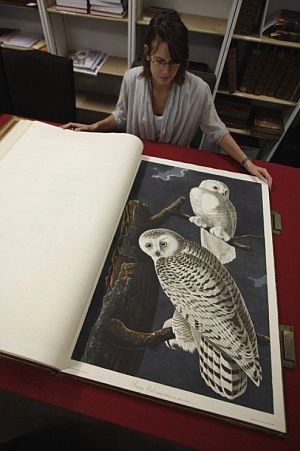
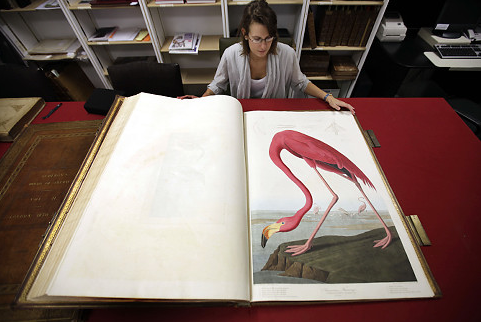
I had only known Audubon through the version of The Birds of America book I had, that measured a scant 14” x 10.” So when the Audubon paintings came to town, to the DeYoung, John James Audubon: The Watercolors for The Birds of America, Feb 3- April 14 1996 it was a life-changing experience to see in person the enormity of his double elephant folio pages measuring in at 39 1/4 ” x 26 1/4” with the birds depicted life-size. Although the prints are a wonder to behold, the only way to see the delicacy of his hand work is in the original and it takes a keen eye to be able to discern some of his techniques.
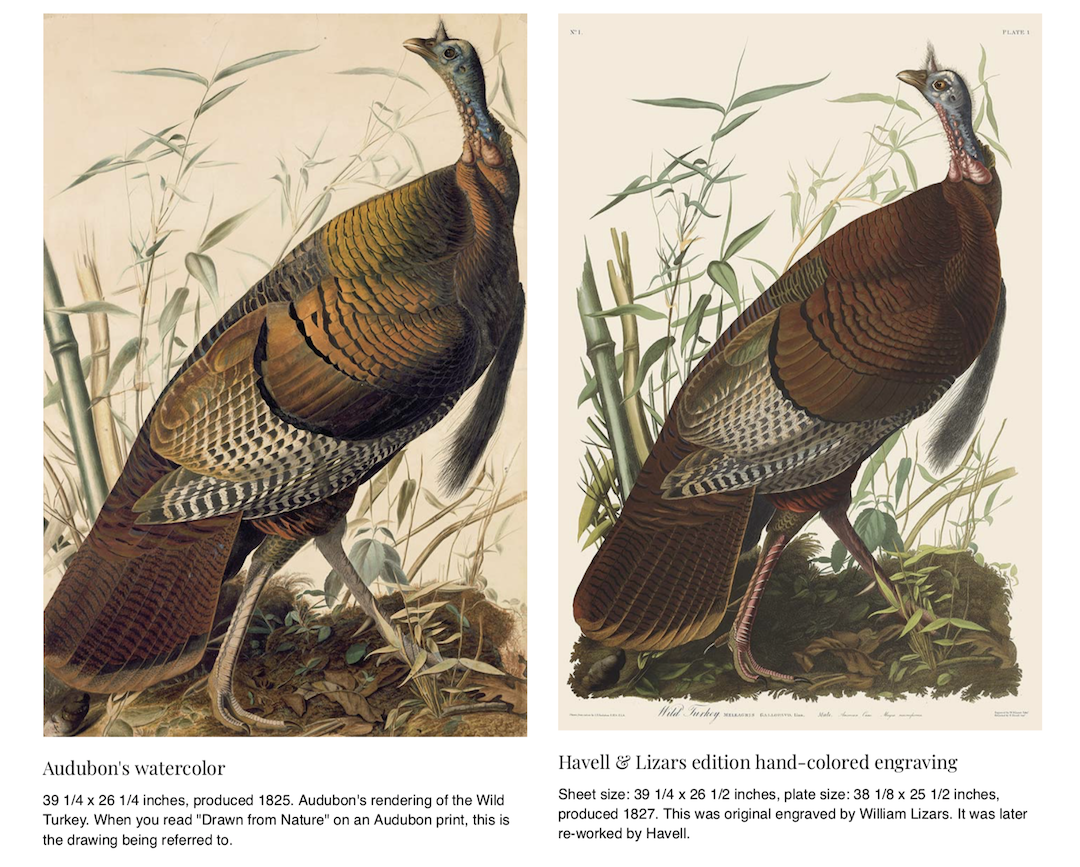
I had always only thought about Audubon’s as “prints.” It was a revelation to see his original artworks and to compare with the hand-colored engavings we have come to know in the folio plates.
It was a shock to learn that he was a cut and paste guy. If he liked the bird but not the background, he would cut it out and change it up. Or, if an area was just not right, he would paper over it and begin again, integrating the correction into the original. Old drawings were re-purposed into new. Audubon’s use of a collage was unusual for an artist of that time and demonstrates his inventiveness as he would do anything necessary to accurately depict the bird and its environs.
Audubon‘s watercolors reflect his close observation of living birds. He usually drew and painted from a freshly killed specimen which he threaded with wire and then posed in a manner that was both characteristic of the species and aesthetically pleasing. He would place the specimen on a square grid to help replicate on paper the proportions of the bird. Audubon began by sketching the birds main outline with graphite that he would then paint with watercolors. He usually applied watercolor in a few thin washes but sometimes built up many layers and even used gouache to create dense areas of solid color. Later he would use the metallic sheen of graphite to enhance and clarify details and to add iridescence to the feathers. He used pastels to capture the soft textures of the birds plumage. Transparent glazes of natural gum or gelatin applied selectively made the eyes and the feathers shine and intensified the colors.
It was with Audubon’s expansive vision and permission to experiment, that I took flight with my own explorations. And, it was with Audubon, that I found my animal spirit.
Quail, Hummingbirds, Jays, Crows, and Chickens are the avians with whom I have daily communication. They are not exactly wild. They depend on my regular tending — cleaning and filling of the hummingbird feeders, cleaning and filling of the chicken feeders.
Around here Scrub-Jays let everyone know who’s boss. They rule the roost as it were. This time of year they are busy storing up acorns for winter, secreting their stash, making sure that no one sees where they are caching their food.
Scrub Jays
Nearby the crows sit atop our apple tree pecking at the fruit while the deer wait below for the fruit to drop.
American Crow
Every morning a covey of quail circumnavigate our yard, churring and calling out to each other. From atop the fence post, a vigilant male reports about conditions ahead, announcing “all clear.” In a flurry of dust they all take a bath on our dirt driveway.
California Quail
It’s a busy place with the scurry and flight of these common everyday birds. But, these days, the dawn chorus seems different and scientists, in fact, report that it is. Since Covid sheltering began in March with a decrease in human and machine generated noise, birds are changing their tunes. Since they no longer have to compete at a higher volume, they are embellishing their songs. National Geographic has the story with audio clips of the birds before and during the shutdown.
Quiet is better for the birds and it just might be better for us.
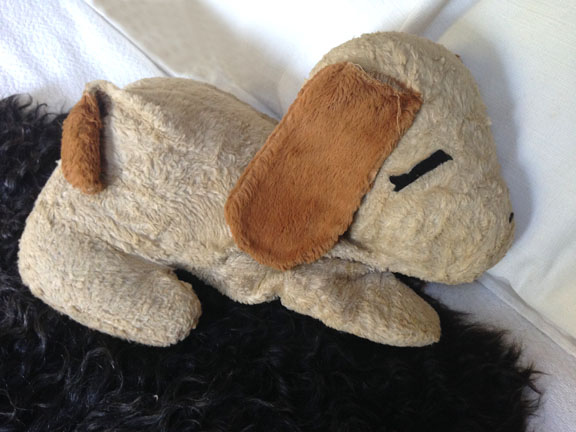
I would be totally remiss if I did not mention that long before I had even heard of having an animal spirit guide, “Arfie” my most favorite cuddle toy, snuggle puppy, was my confidant. At night, before going to sleep, I would roll up his long floppy ears and whisper my private thoughts and deepest secrets. His zippered pocket pouch was intended for stuffing PJ’s but I spent more time with my hand in the pocket feeling around the stuffing, searching for his guts, and for the life of him. Although “Arfie” is now tucked away in my foot locker with my other childhood memories, I treasure the nighttime dream hours we spent together.
Just when we thought the human news could not get any worst: this week it did.
Do we really need to make a list to remind how bad it has gotten? The vitriol and ranting during the presidential debates set a new low. Fears are being stoked about the intersection of the flu season and the ongoing Covid epidemic. There is rampant unemployment with uncertainty roiling the financial markets. Fires are burning throughout the West. The air is a thick mix of fog and smoke, laden, claustrophobic. Even wearing a mask, rather being about taking care of your self and others, has been politicized.
It’s hard to not feel depressed. Amidst the gloom of these sad and challenging times we need to find ways to heal from the psychopathic politicians and greedy corporations.
Last evening, the birds did it. The Golden-Crowned Sparrows were right on time. At dusk I heard that familiar trill, whistled notes descending in tone, announcing “hey, honey, I’m back.” Back from their summer trip to Alaska, three thousand miles back to here, to winter over; their arrival is so reassuring, reminding that even if the human world is in trouble, birds will continue to sing. Just listen…
In 2012 Richard wrote Ming’s Return. Amelia returned and so did the Golden-Crowned Sparrows.
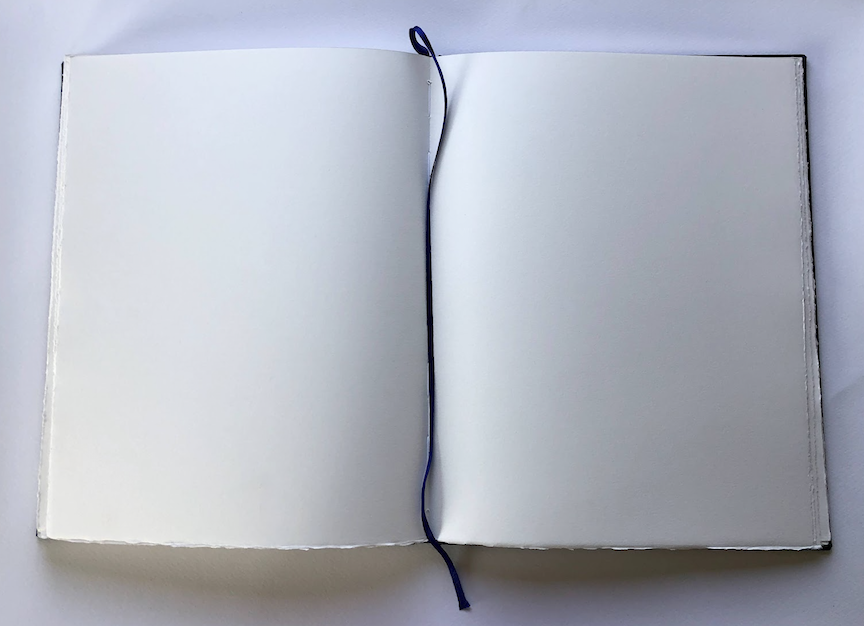
Since July 2017, the beautiful book you sent had been tucked away in the closet. I could hear its muffled voice calling out, for days and years, as it remained in the box it came in. The luxurious pristine blank pages triggered a serious case of artist block. Nothing quite like a white sheet of paper to intimidate and even more so, a bound book with many blank pages.
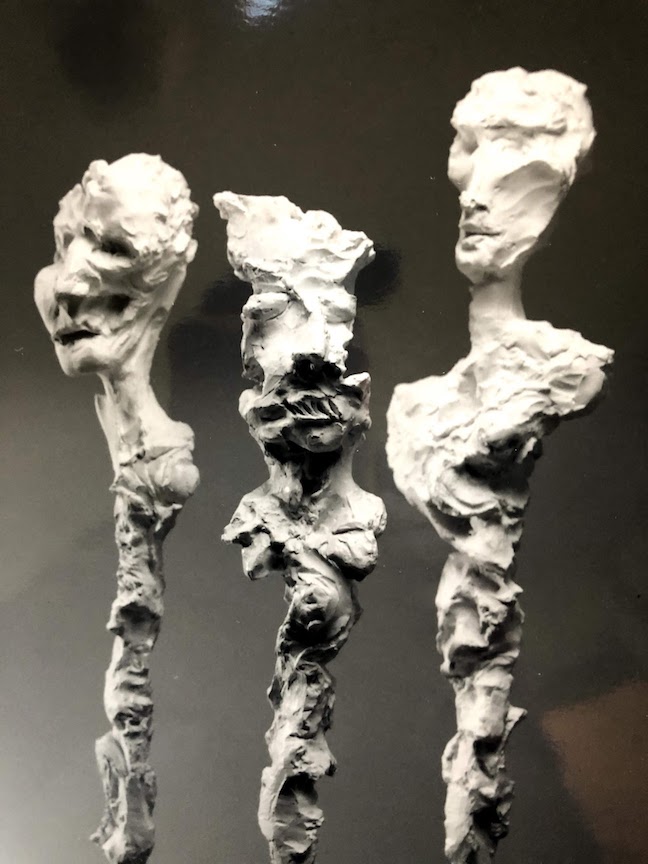
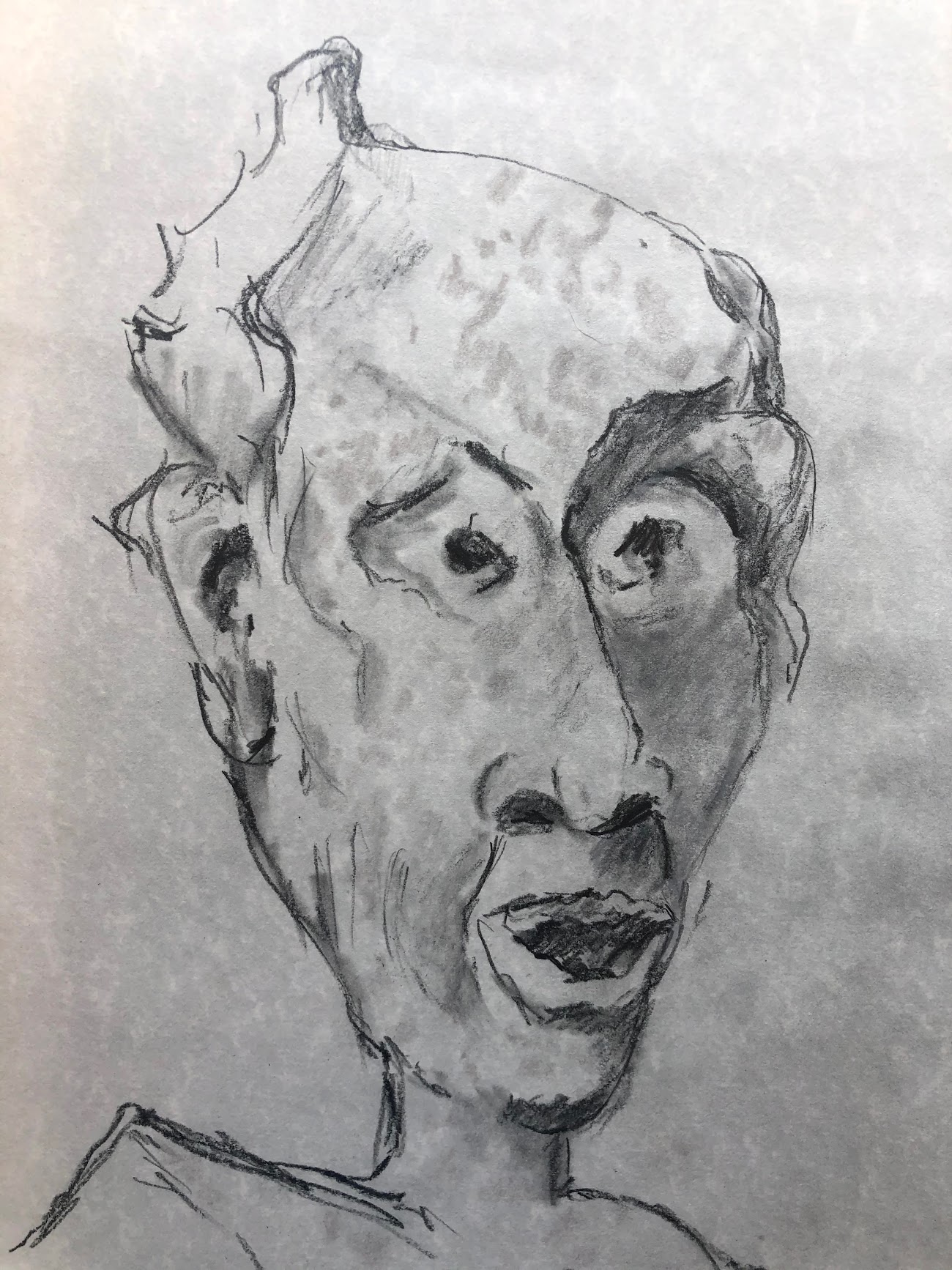
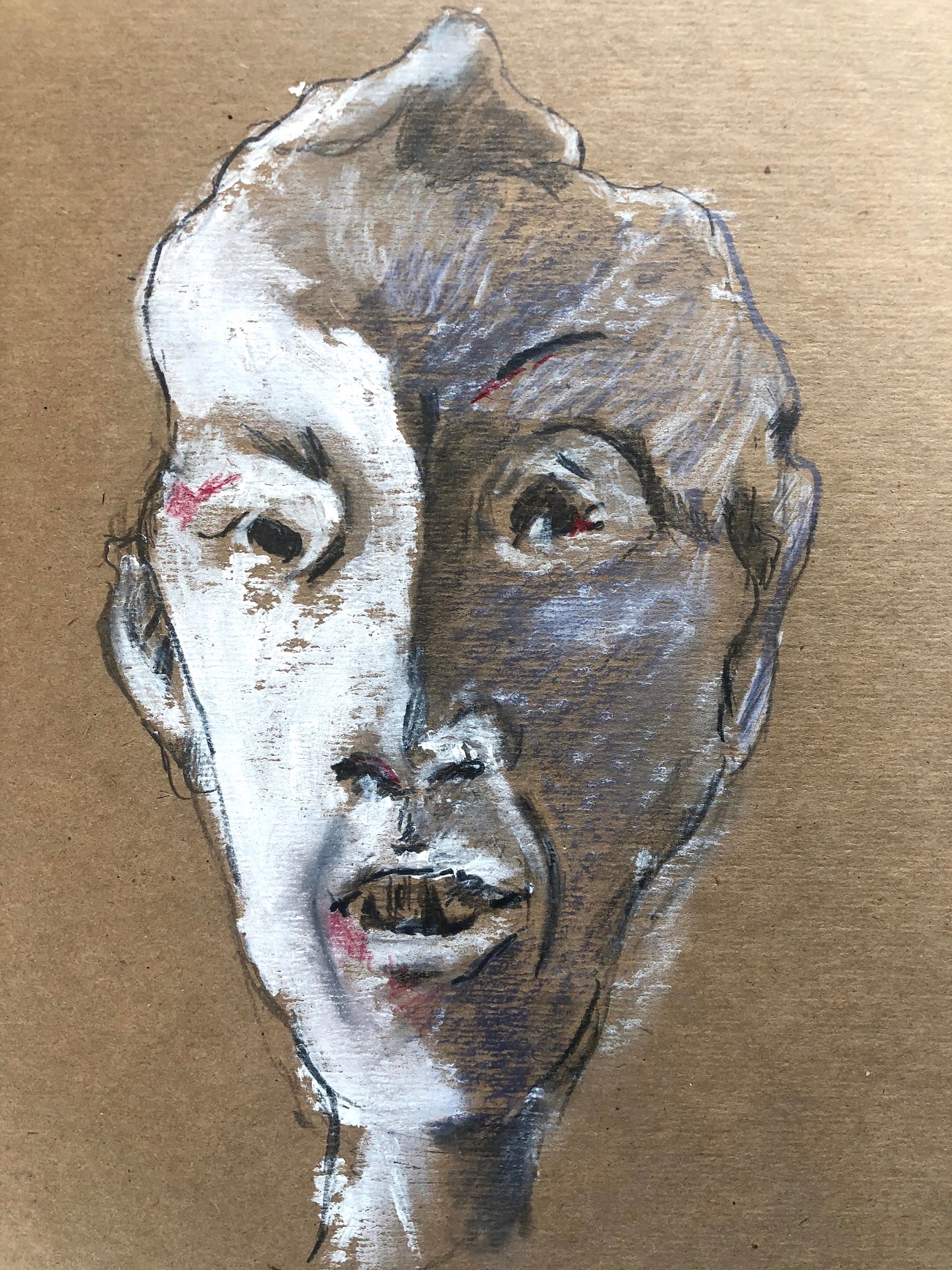
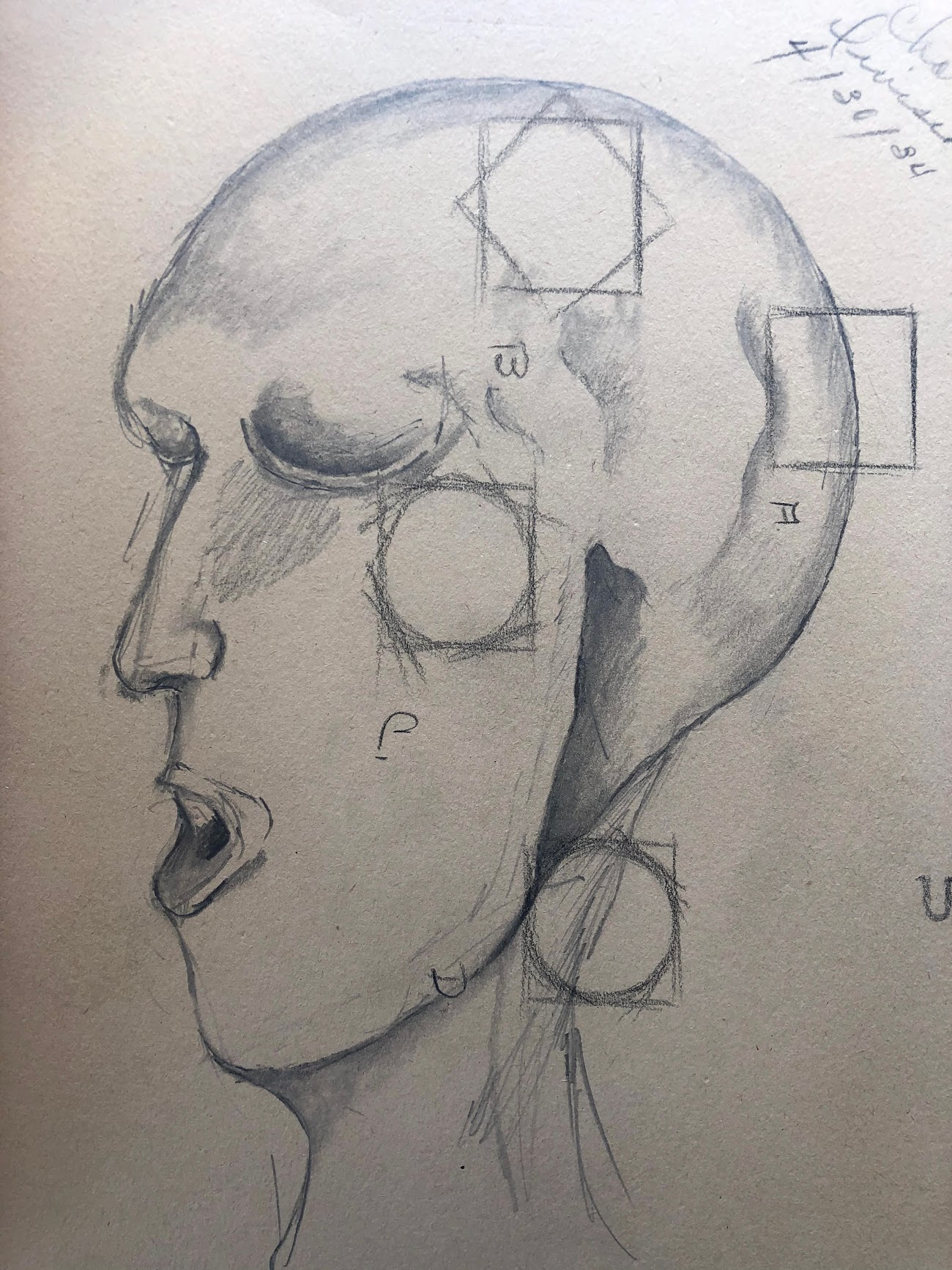
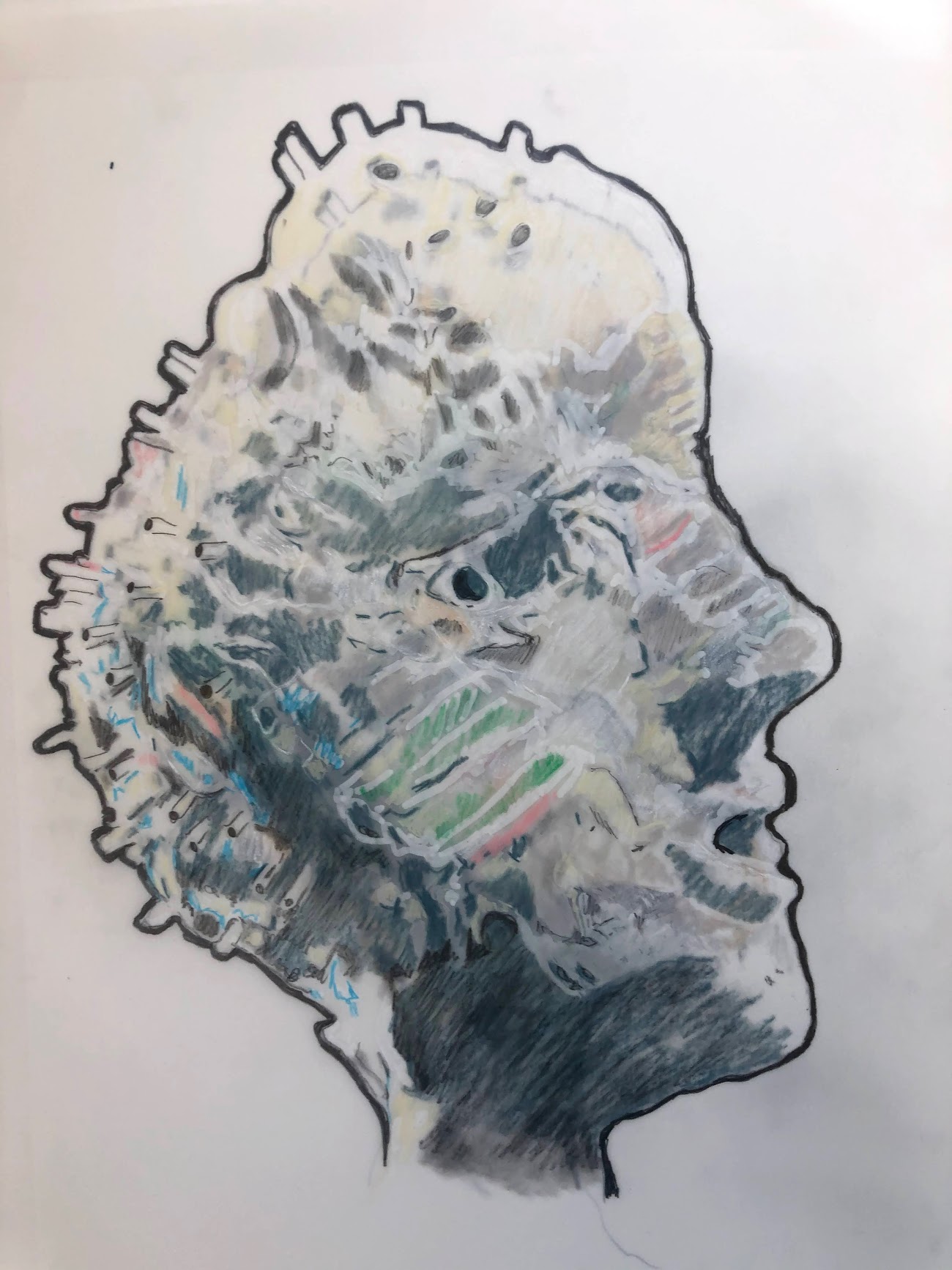
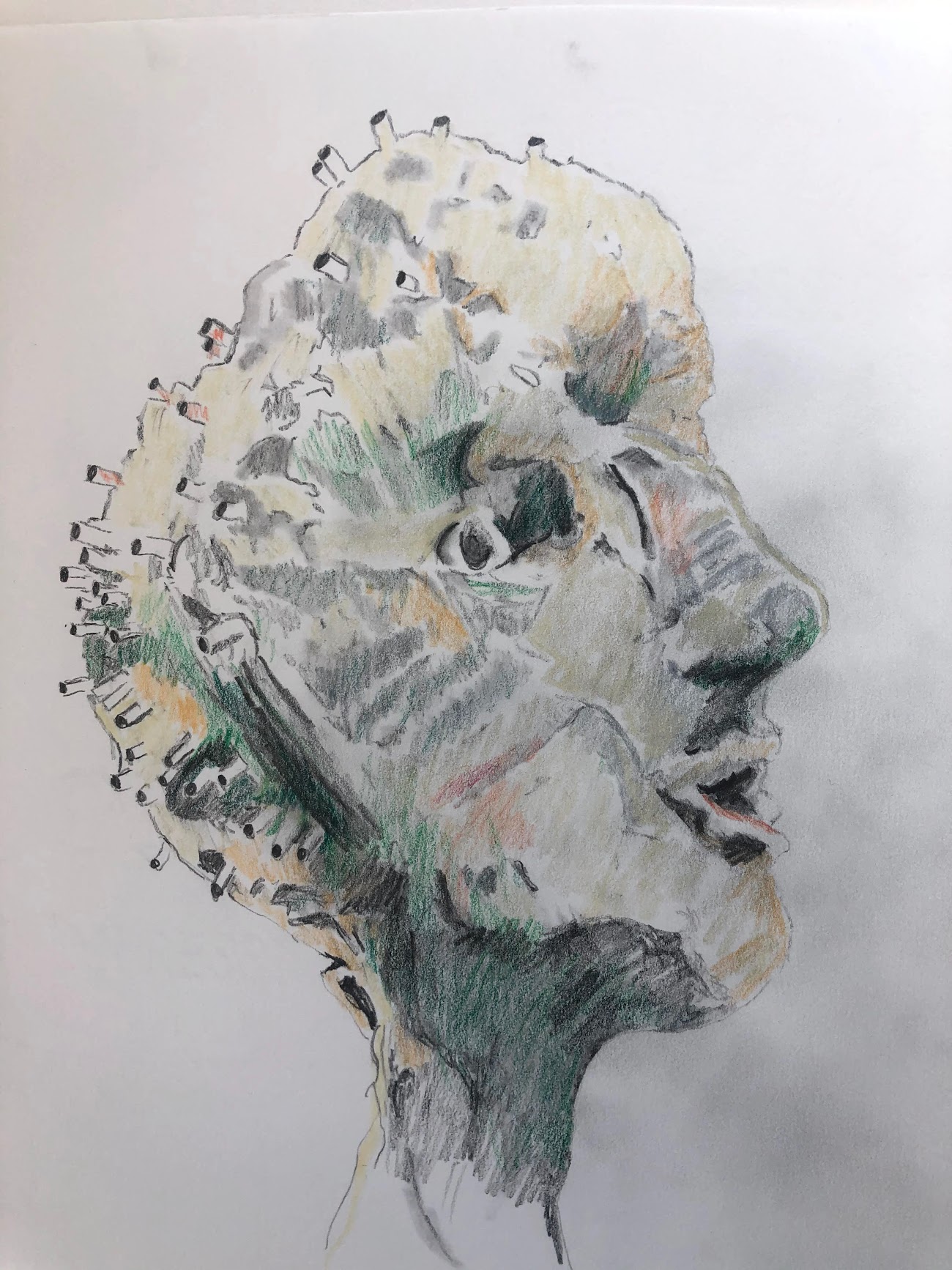
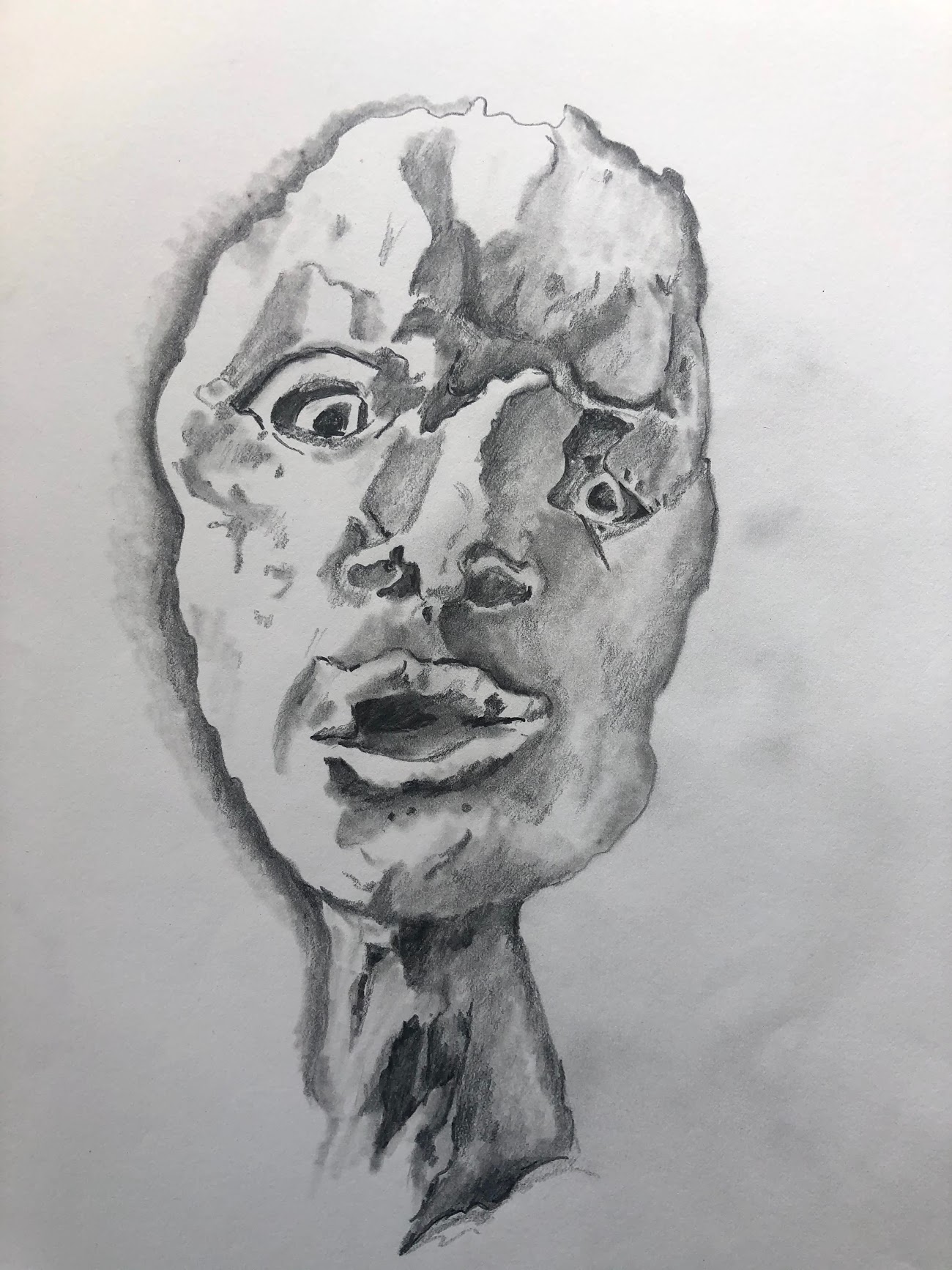
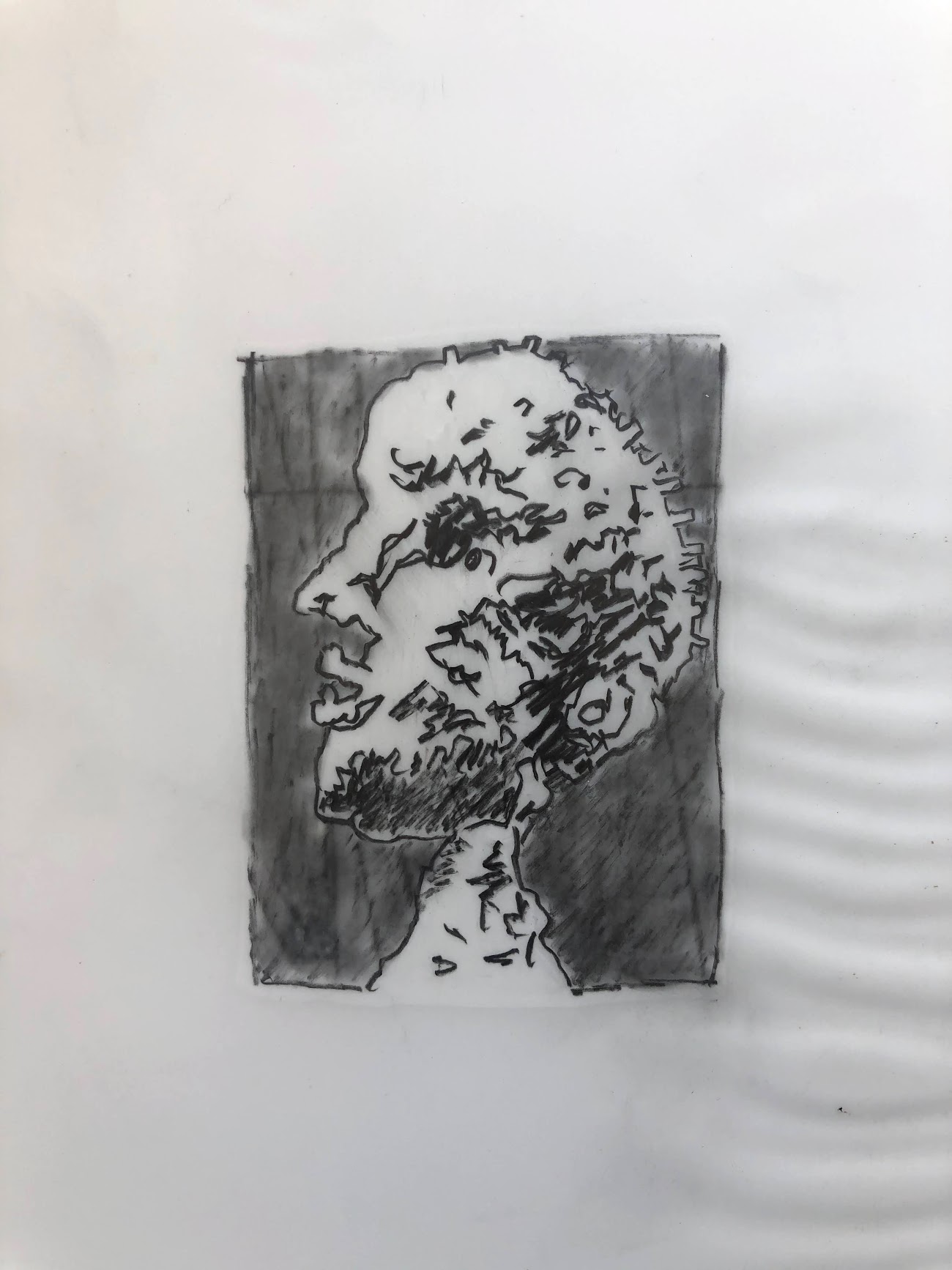
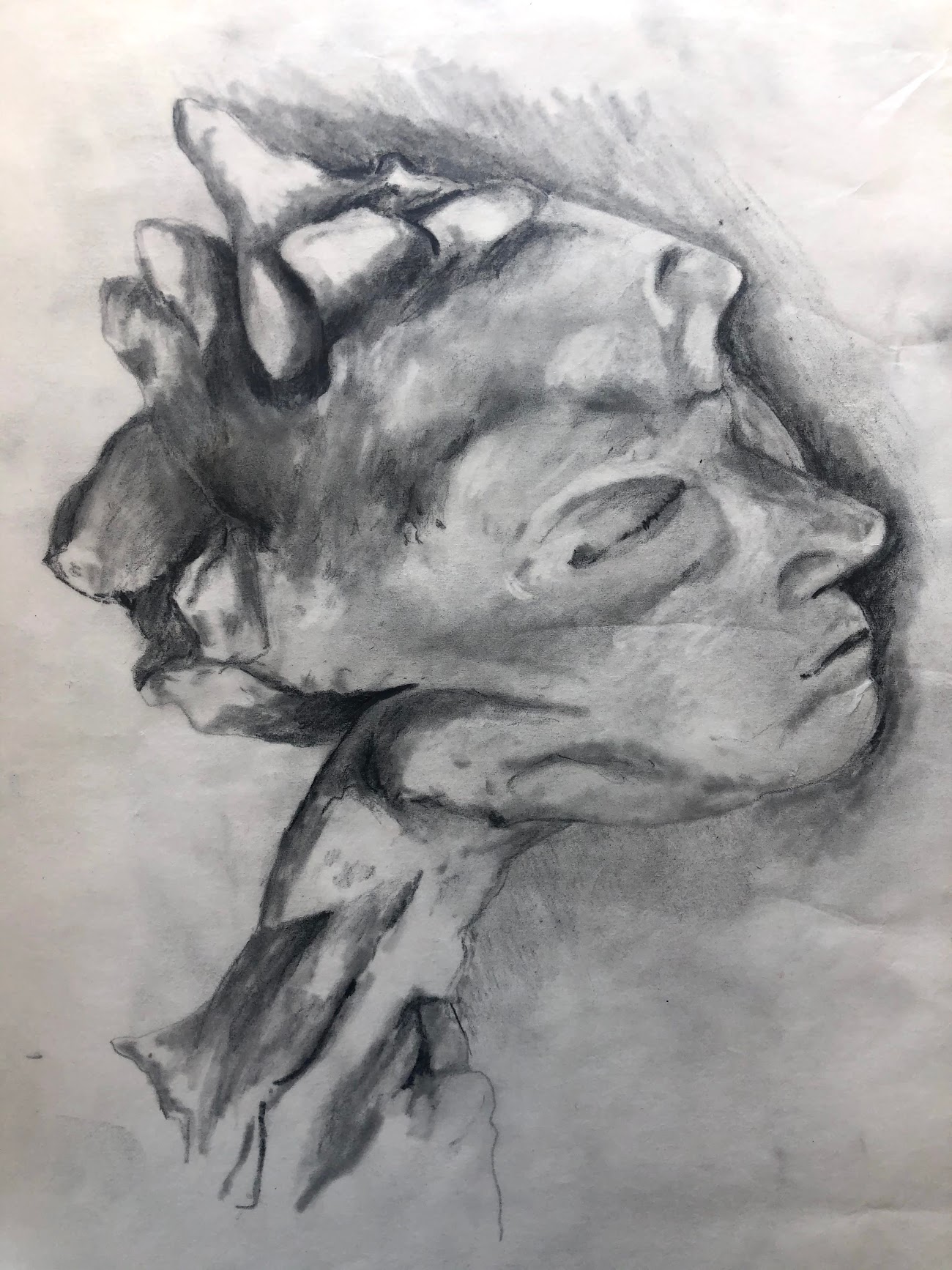
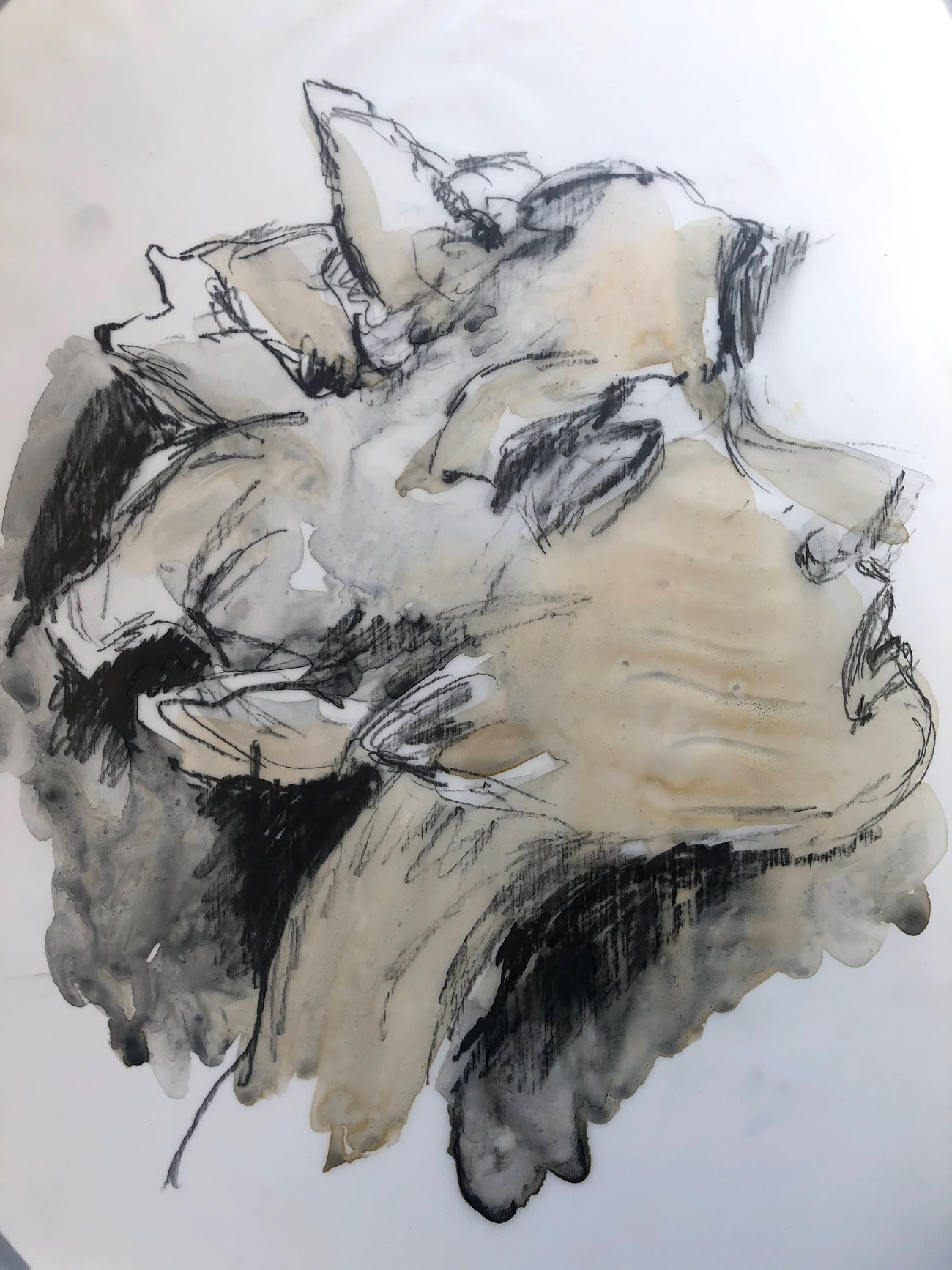
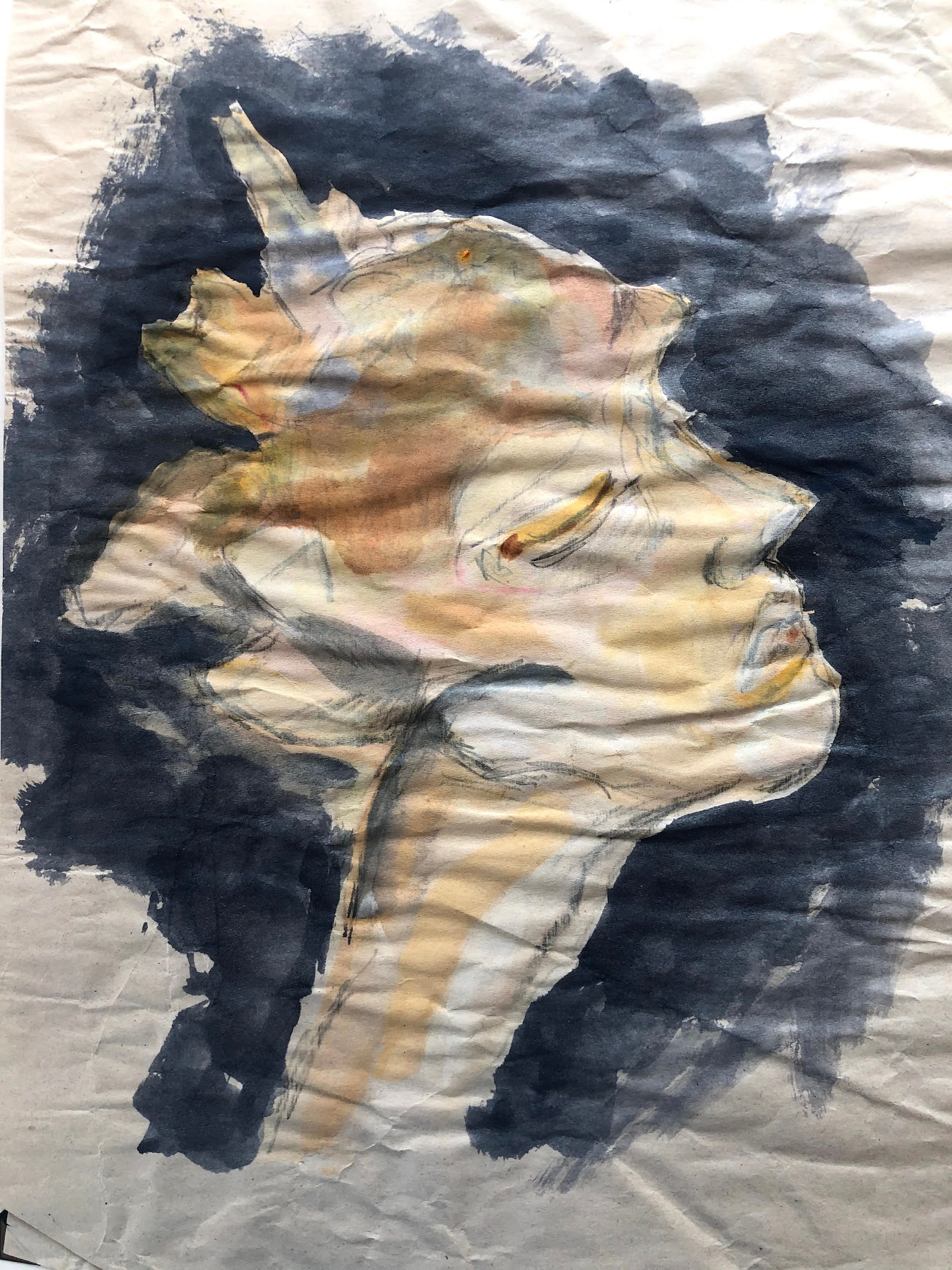
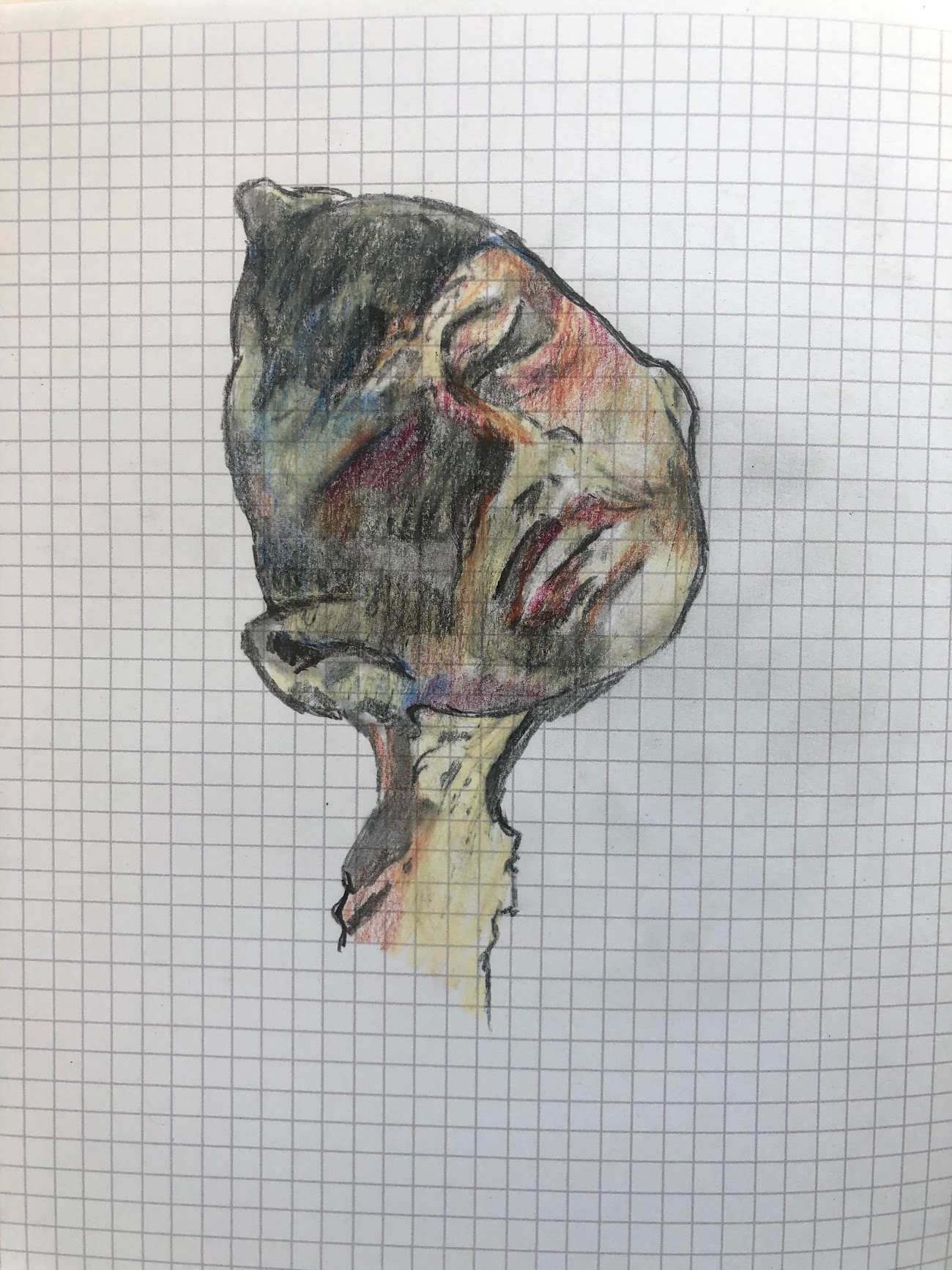
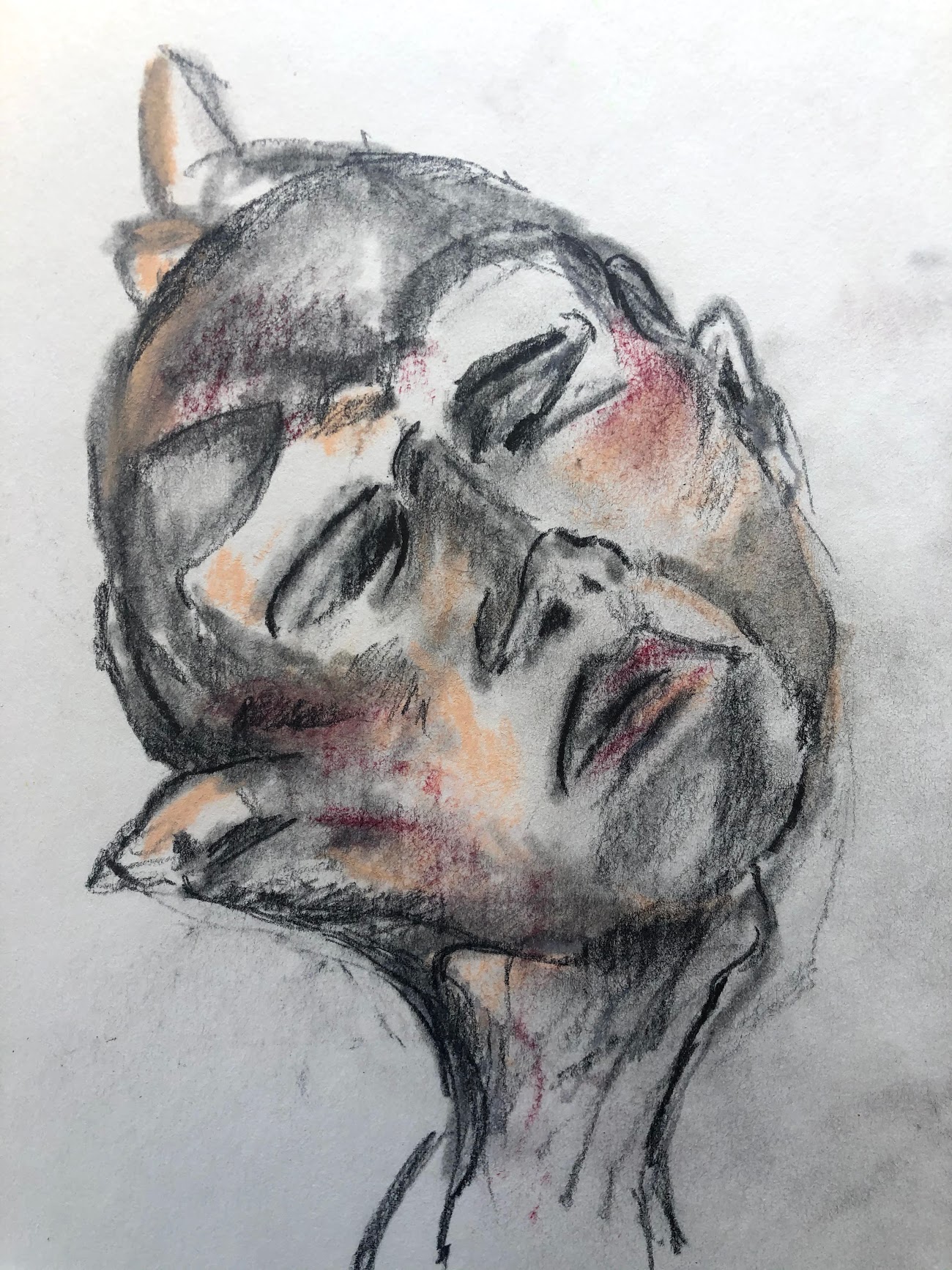
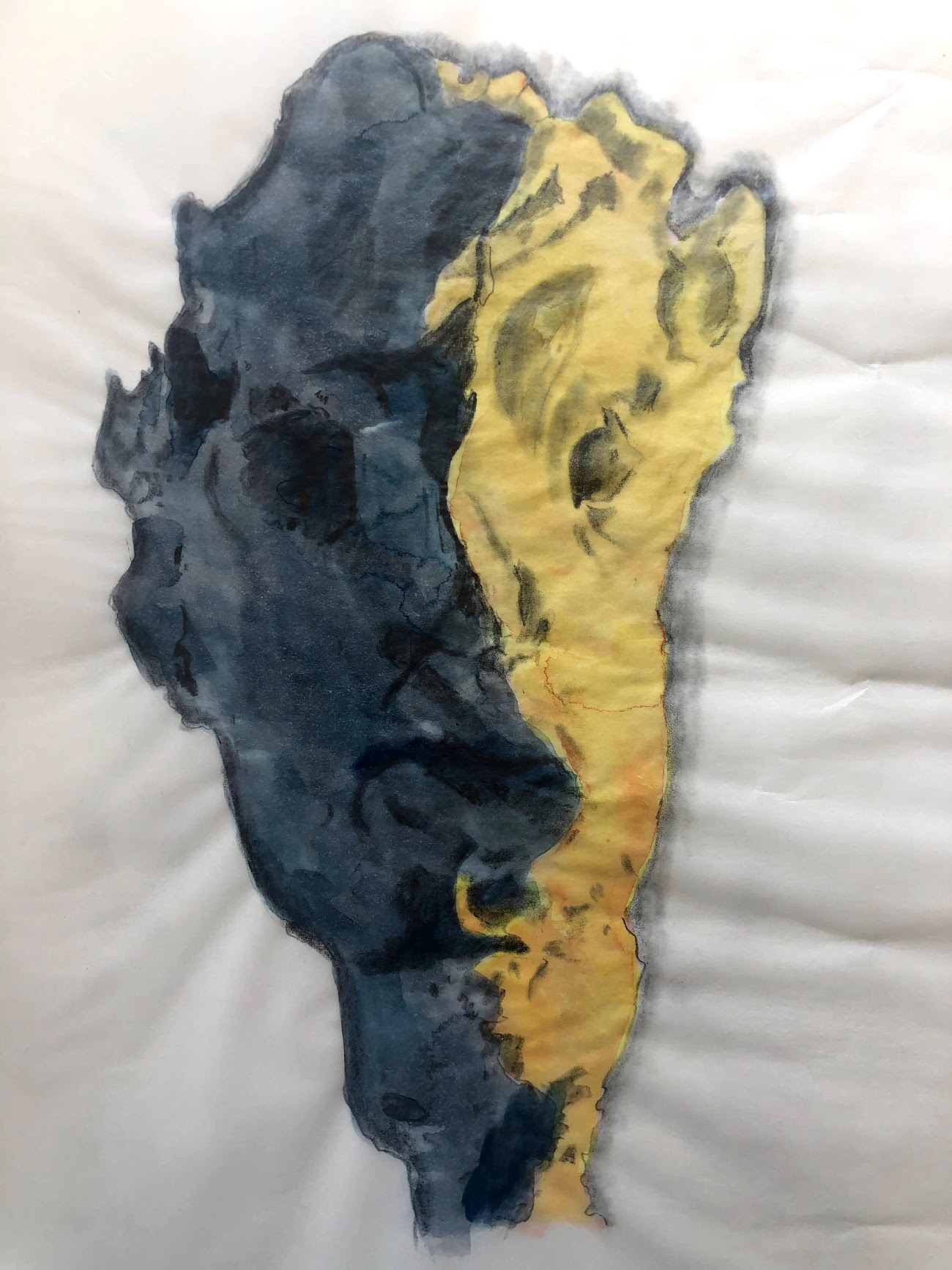
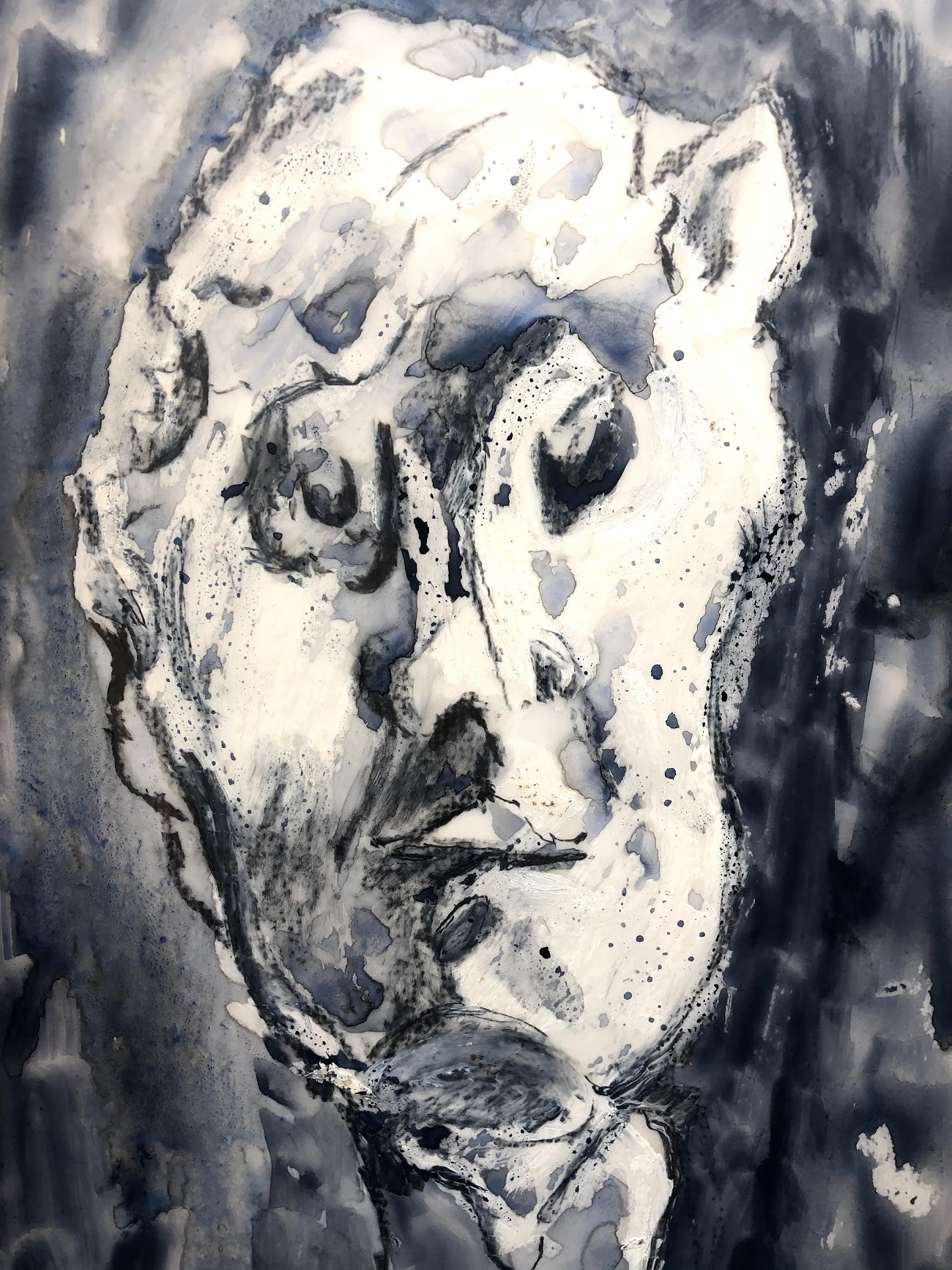
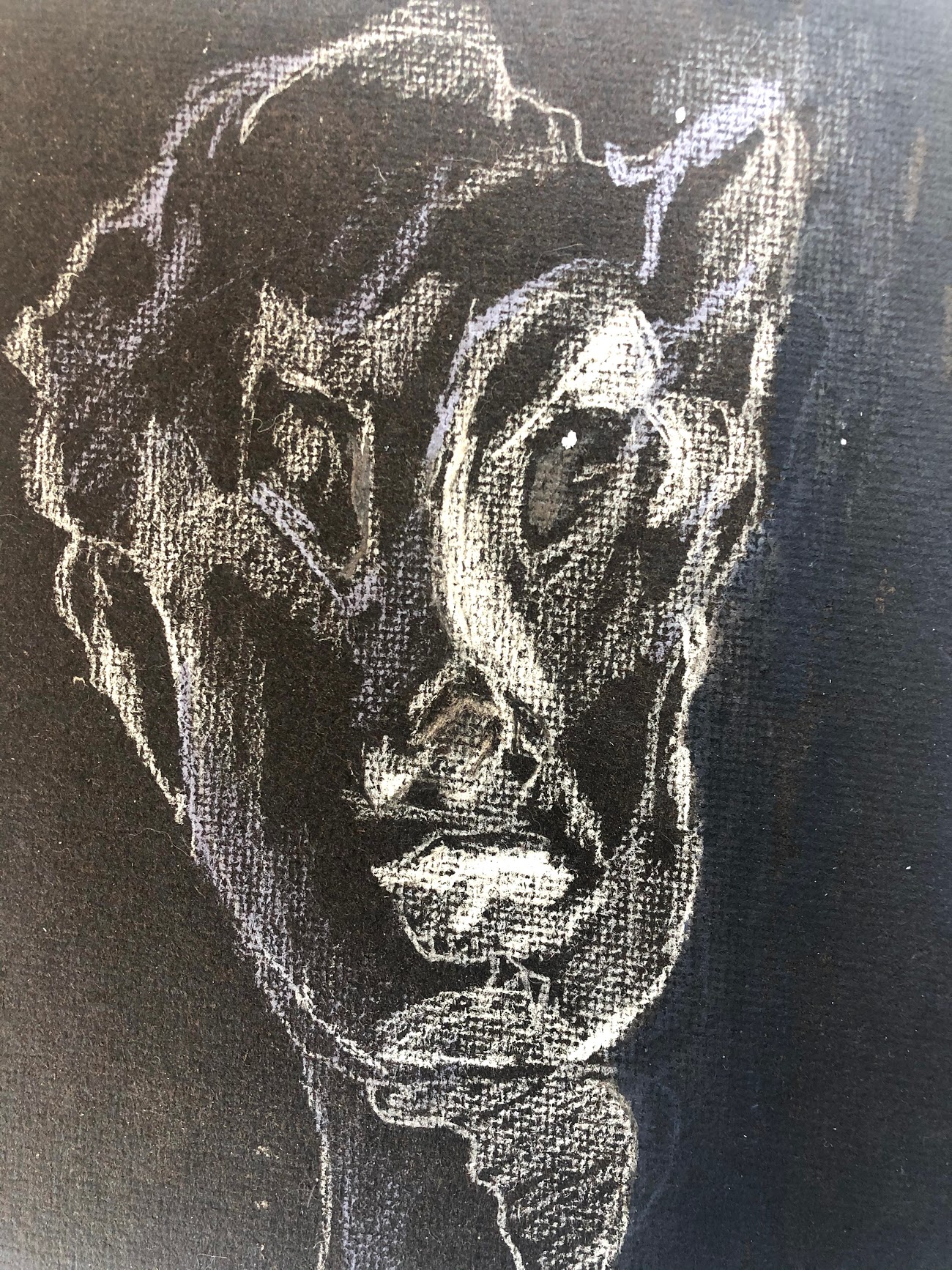
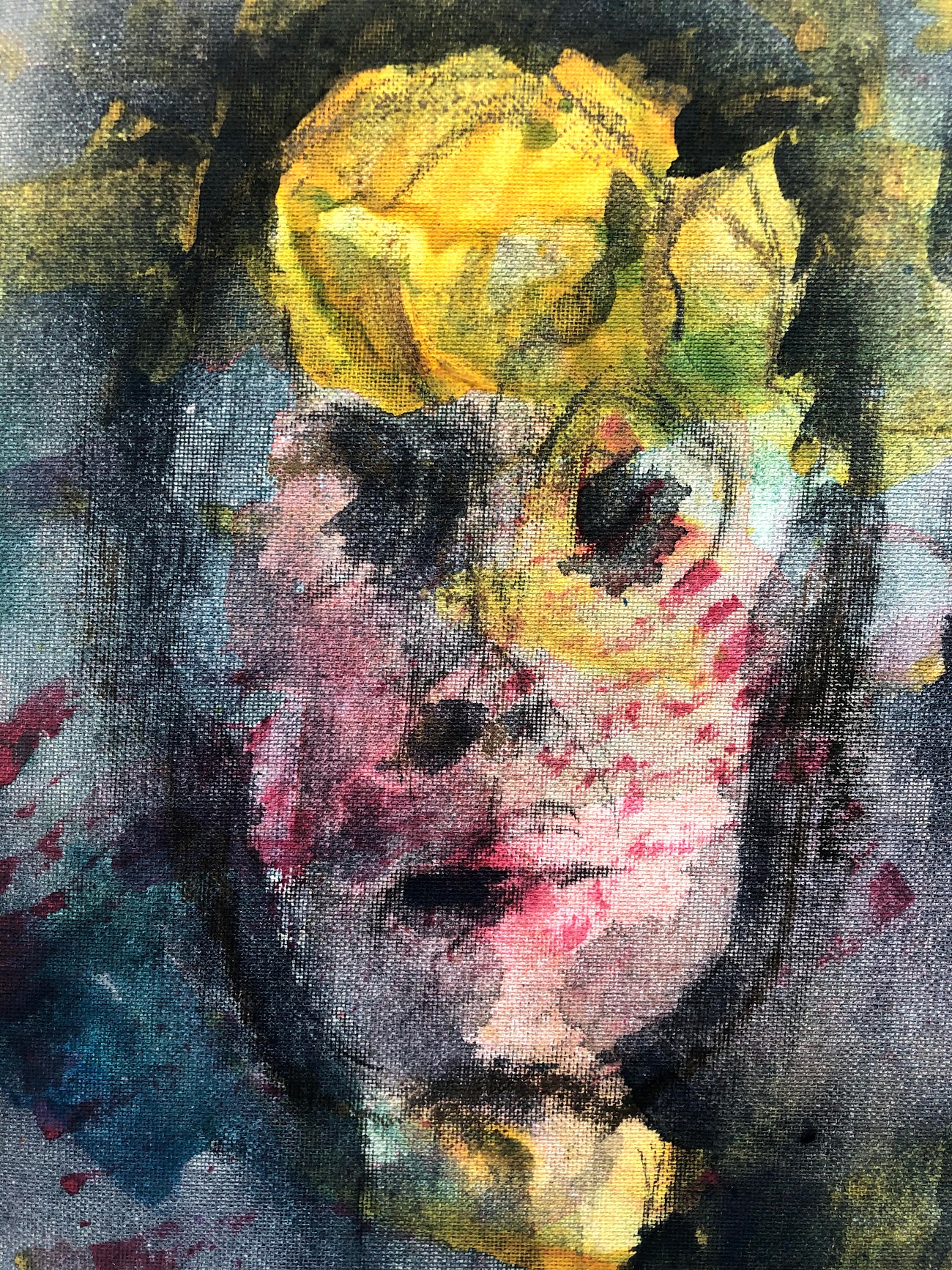
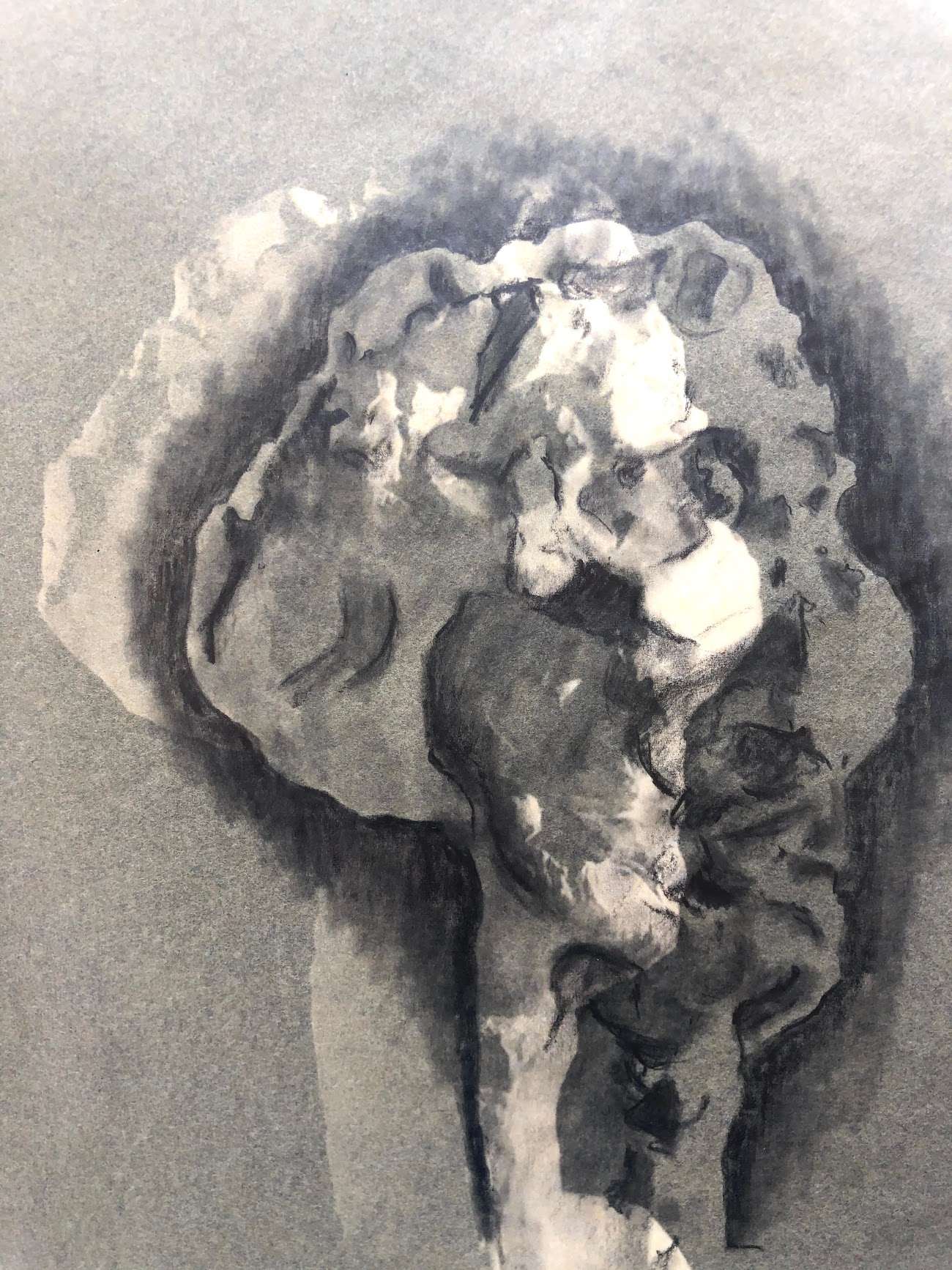
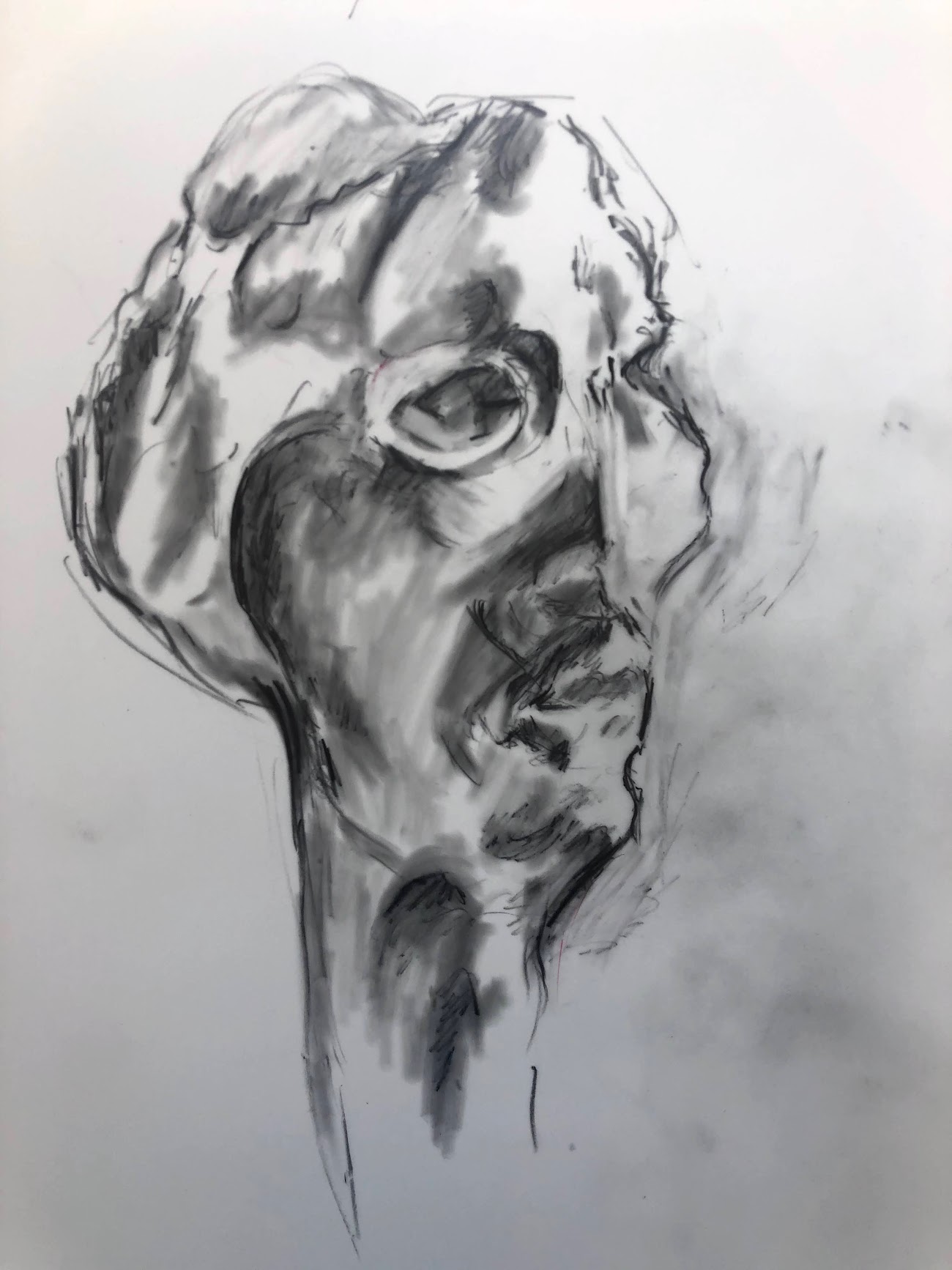
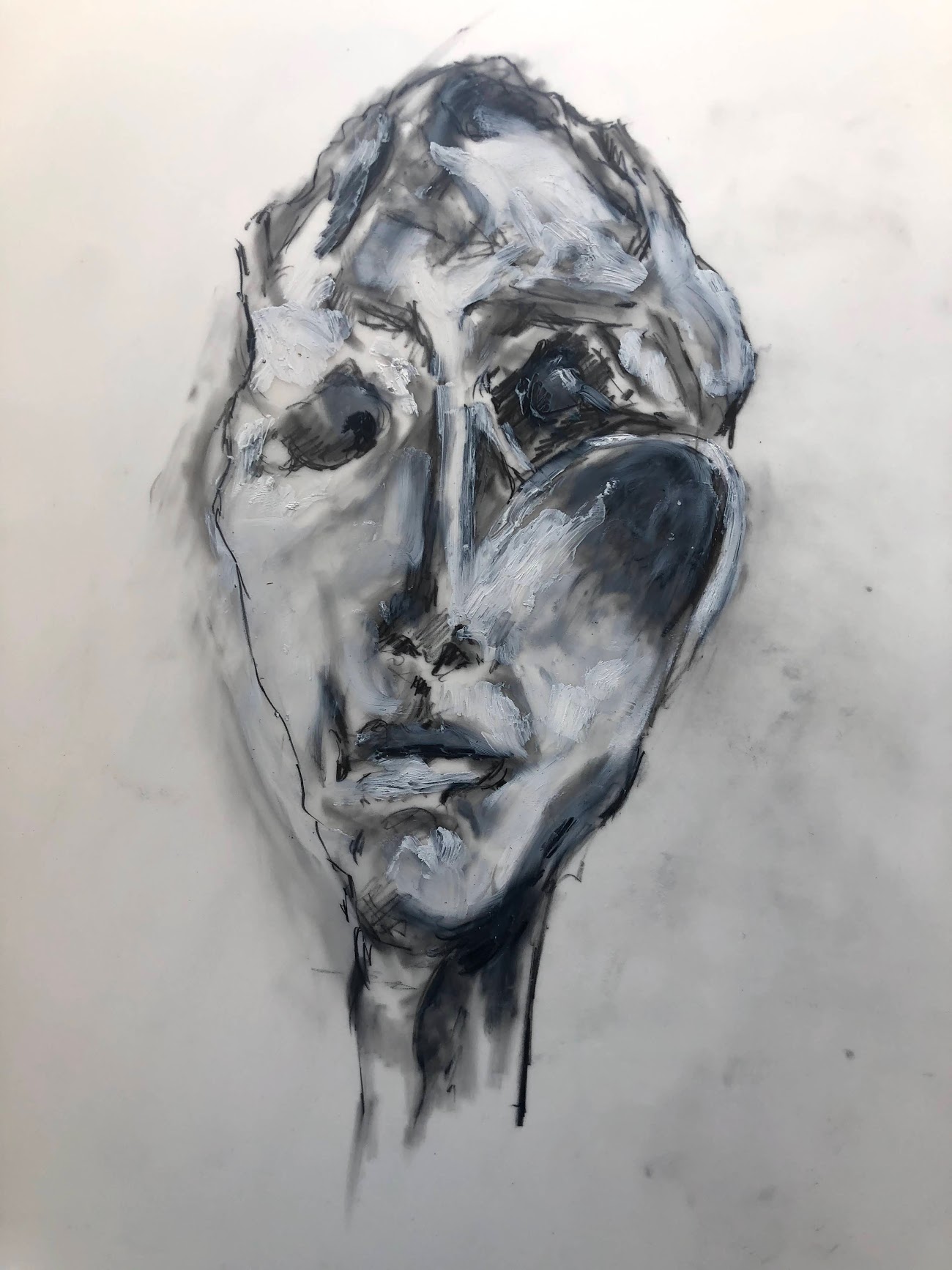
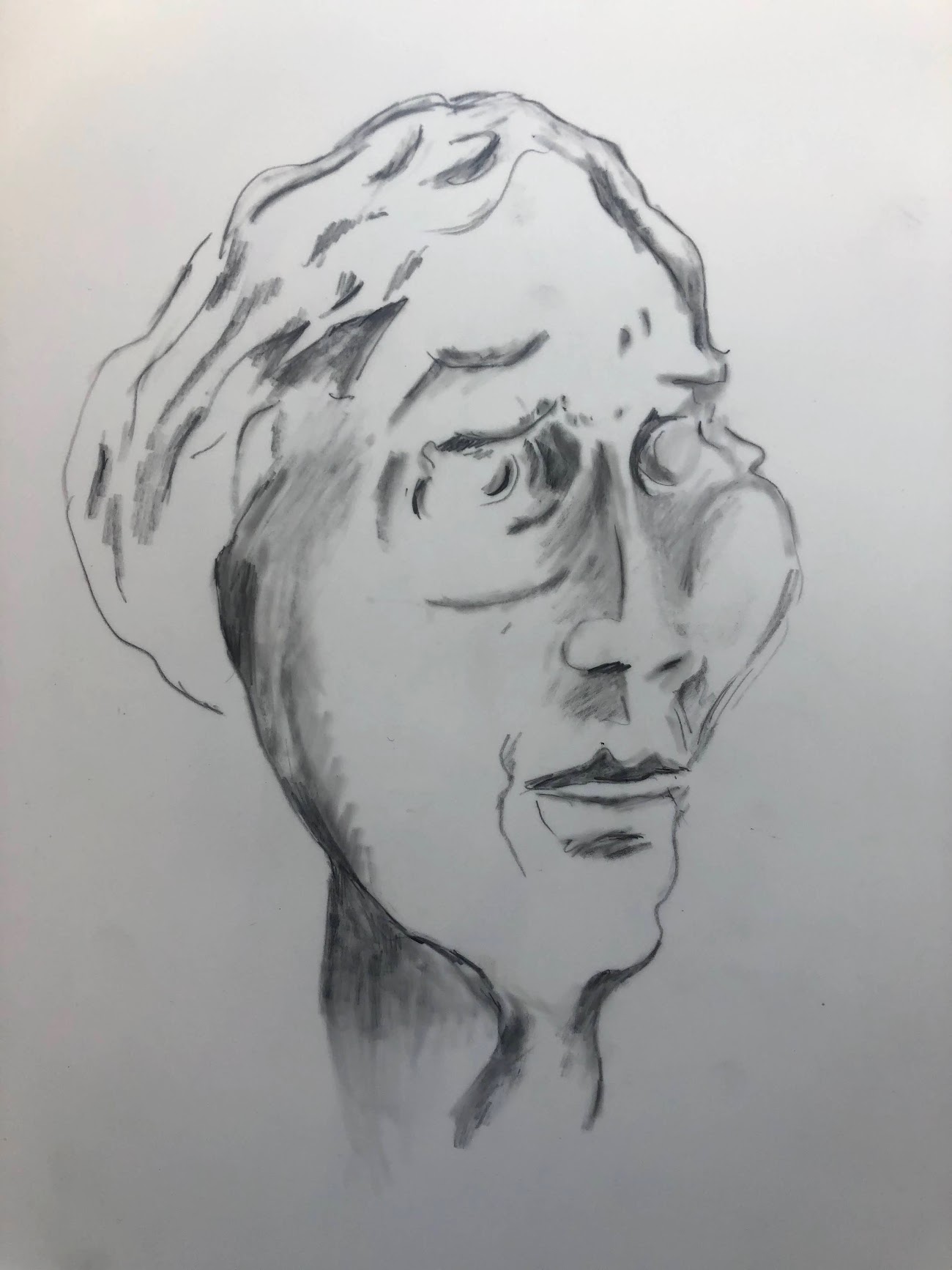
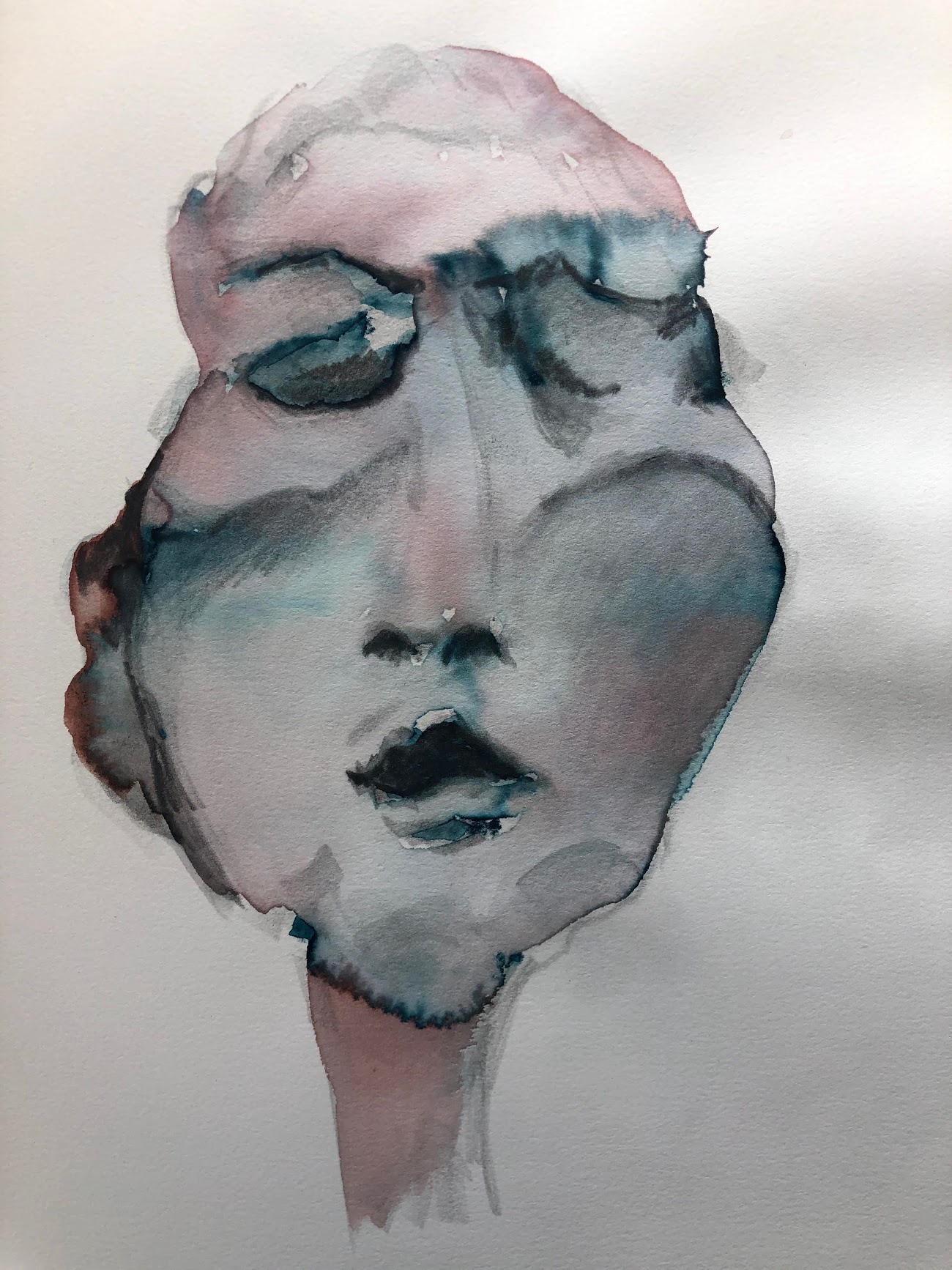
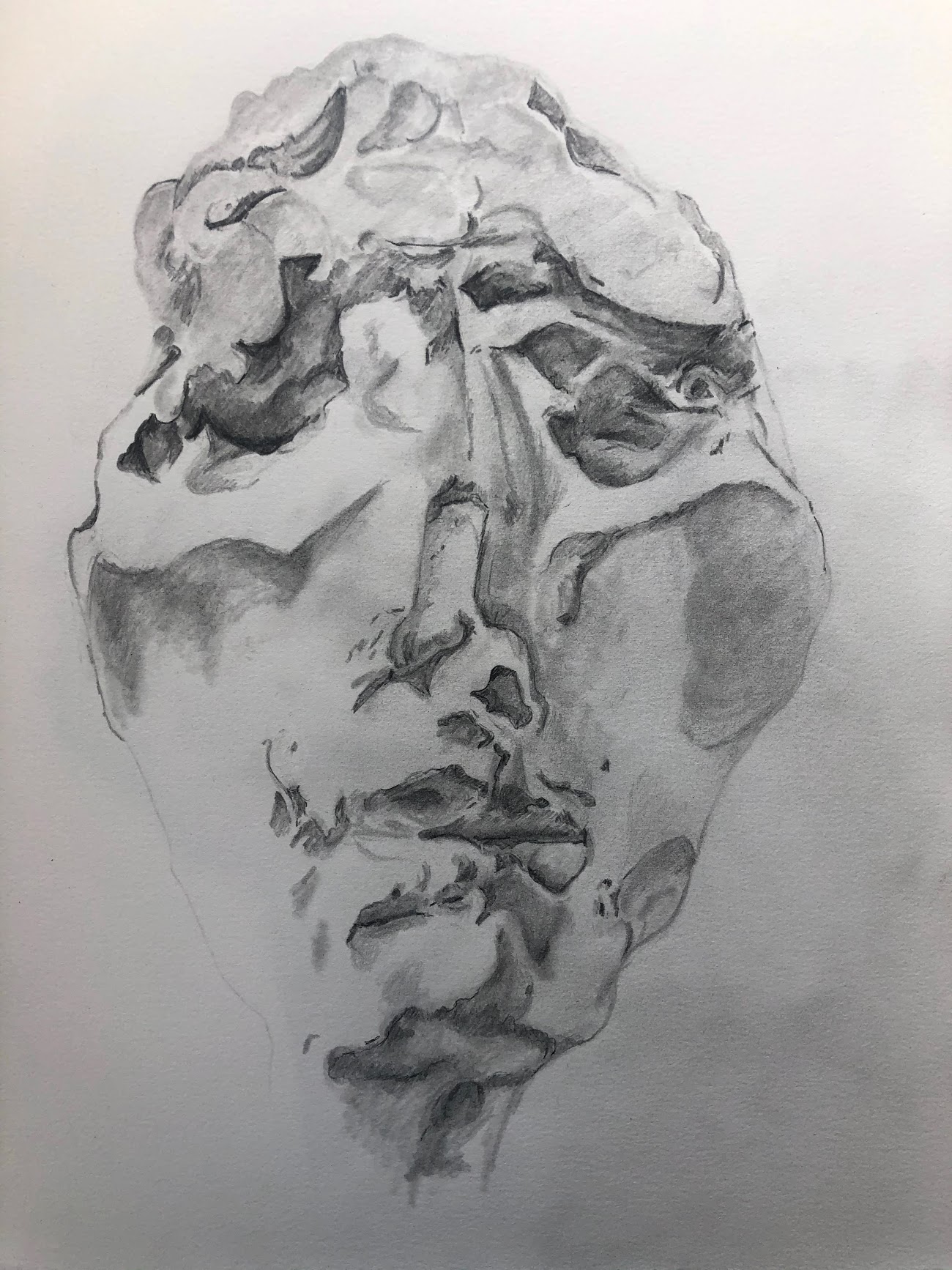
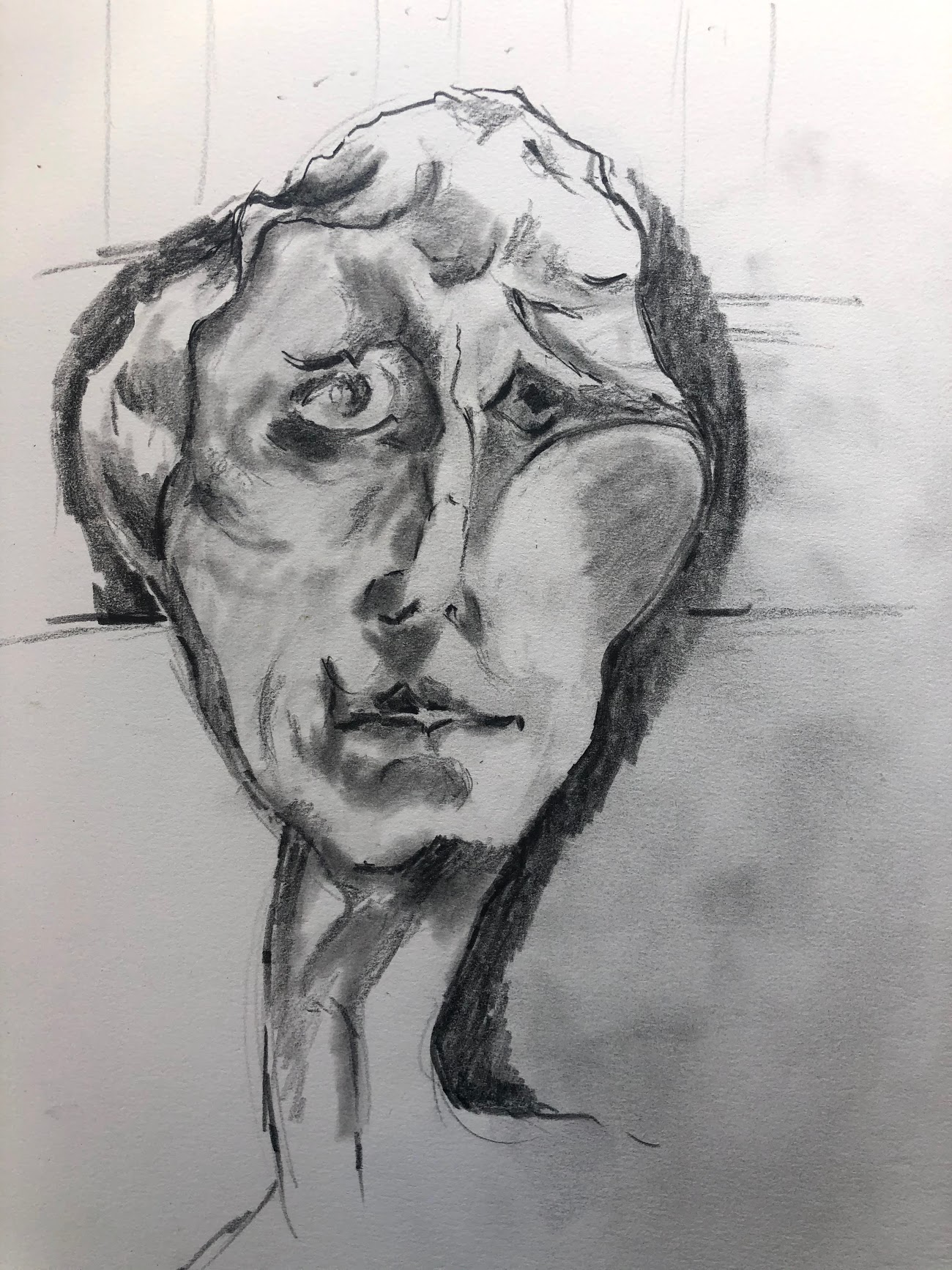
As COVID-19 began to impact our lives in early March, we began sheltering-in-place so my art practice moved closer to home — we don’t go out much. I am using just the materials I have at hand. I was longing to return to my roots, my deep love of doing portraits. But, since we rarely see anyone, and someone sitting for a portrait is not possible, I turned to a group of plaster portraits figures ’84-’87 that are now standing in as my models. They are perfect because they have been holding the pose for years and are intent on holding it for-ever.
These ghostly sculptures titled Pieces of I (individuation) were done during a time I was experiencing much physical pain coupled with the difficult struggle to find my artistic voice. The heads were first shaped in clay then cast in plaster. The malleability of the clay was the perfect material for expressing the anguish and transformation I was experiencing. The casting in plaster was a laborious and physically demanding process that involved heavy lifting and much repetitive chiseling that contributed to my pain. But in a certain way the pain, amplified my commitment to my artwork — reinforcing the story of the suffering artist.
Although to some, the twists of the faces may have looked tortured. They may have been difficult to look at. Nevertheless, they struck a nerve. In August of 1984 three of the sculptures had their debut at the 38th Annual Arts Commission Festival at the Civic Auditorium. In 1985, the San Francisco Women Artist Gallery selected myself and painter Marshall Crossman to be the “Emerging Artists.” This distinguished honor, this first real show, gave me confidence and set me on my artistic path.
The press release described my “insight into the continual struggle of the individual to remain unique while becoming, of necessity, a part of the whole, is well expressed in Selby’s sculptural forms. United by the material, differentiated by the shapes, the inner turmoil of the evolving being is being played against the tension of the group. The smooth, confident exteriors are stripped away to reveal the anxiety of personal transformation.”
The headaches and body aches, feeling my head both large and throbbing and constricted like head on a stick, all in Alice in Wonderland way, made me relentless in my search for a treatment. I went through every known medical test to try to find a reason and a cure: biofeedback, drugs, hypnosis, on and on it went. Fortunately, along the way, I was directed to Somatics, an embodied philosophy with a system of exercises that taught me to re-educate my body and posture that saved me and helped me to finally live pain free.
FAST + FORWARD TO TODAY
Today, as if in a life-drawing class, I set-up a sculture standing in as my “model,” direct light on the figure to emphasize the shadows, clip paper to my drawing board, grab my pencil, my stub, and my seat. I am working free-hand, harkening back to the marvelous years of study with Joseph Query that I described in History of Drawing: Lesson Five.
With The Rev as my in-house spiritual guide and art critic, I am heeding his chiaroscuro advice emphasizing the tonal values. It is glorious and intimidating to try to limn a likeness of these formidable figures. As I look anew at each countenance, the expressions on the sculptures seem now even more fit for these tumultuous times. Now the whole planet is in crisis. Personal pain is now politicaland now planetary. I am drawing as if my life depends on it and it does…
Mind Games offers “Alice’s Game,” a guided meditation where one learns to experience a flexibility of body and body image. This exercise plays with being large and small, thick and thin, arriving at a full feeling of being embodied. Listen here:
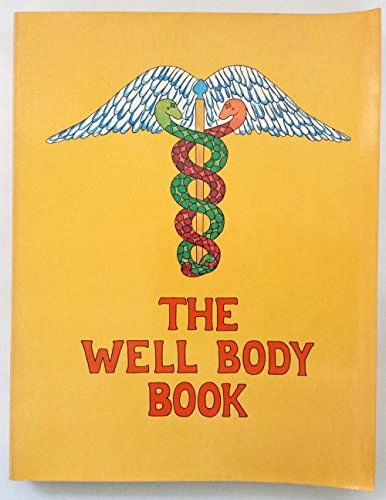
The Well Body Book (1973) is the perfect segue from Mind Games (1972). Both have been life-long guides; with valuable lessons that have stayed with me nigh on to 50 years. Mind Games uses guided imagery to bring into mind a relaxing and receptive consciousness. The Well Body Book uses guided imagery to invoke an imaginary doctor to serve as a healing guide.
Months after graduating college, completing the Mind Games exercises and working with my healing guide, my then partner, Michael and I headed north, eager to get out of LA (from Claremont, really, in the LA smog basin). We had caught the drift of dirt (compost, really) and wanted to get to someplace country where we could sink our hands in.
Just get off of those LA freeways without getting killed or caught….Guy Clark sang it and we belted it out too. Since those lyrics express one of my most important life events, mention was made of that sojourn and the song in The Future of Art 10. Utopia.
I did get off the LA freeways without getting killed or caught but it was on the Alcan Highway in the Yukon Territory that I bit the dust.
On a mission to get away from the smog and traffic-filled Los Angeles, we adventured forth, on the lookout to find a new place to settle and live the back to the land dream. Along the Alcan Highway our car hit the skids and rolled over and over down an embankment. It had rained the night before, making the dirt road super slick. While rounding a curve our tires did not hold and over we went.
As soon as we escaped the car, crawled away for fear of a gas leak and explosion, I realized I was injured, badly; bleeding. Michael reminded me to invoke my Well Body healer guide, remembering that my body is a 3,000,000 year old healer; that the forces would rally — mighty white blood cell were already on the way to the site of injury.
Like a mantra I began to whisper to myself, over and over again:
— my body is a 3,000,000 year old healer.
— my body is a 3,000,000 year old healer.
— my body is a 3,000,000 year old healer.
These words gave me the strength and the confidence to let the healing begin.
After an almost a two hour wait, an ambulance finally arrived and I was rushed (as rushed as one can travel on that treacherous road) to the hospital in Whitehorse, Yukon, 5 hours away. Without even a question about my ability to pay, ER staff gave me expert care. As I was rolled on the gurney in to the emergency room, as if in a dream, I heard the radio announcer reporting a news item about an accident that had just happened, describing the slick road, the roll over and the injured passenger.
Days later, fitted with a neck brace and a cane, I left the hospital and joined Michael who had set up camp on the banks of the Swift River where for two weeks in the fine company of bears and mosquitos I continued to heal.
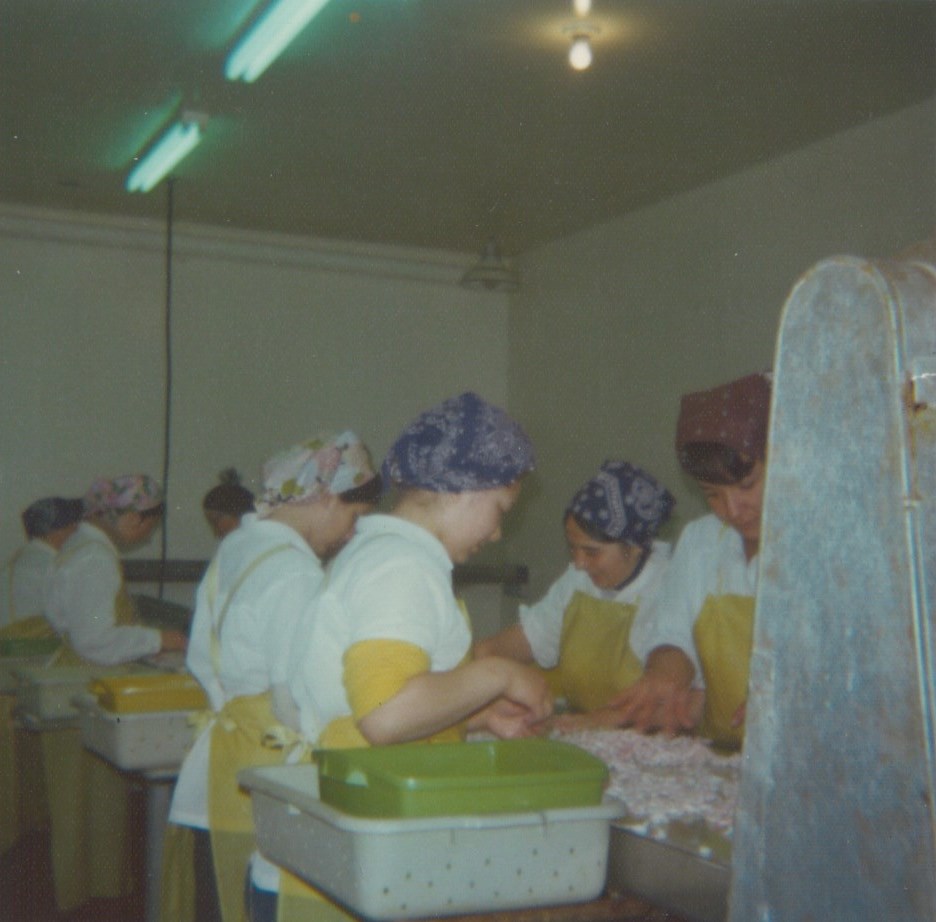
Since our car was totaled, once I could manage a wearing a backpack, we continued our journey, sans car, thumbs out. There was no going back, we would go, onward on our way North to Alaska, onward to Anchorage. It was easy! Sympathetic drivers, seeing my neck brace and cane, would screech to a stop offering to help us. But, by the time we reached Anchorage, we were short on cash. We heard that canneries on Kodiak Island were hiring. In a leap of faith we used our last $7.00 for the passage on the 9 hour ferry ride from Homer. During the shrimp season there were jobs aplenty. We worked 12 hours a day, 7 days a week, making double and triple time pay plus all the shrimp we could eat. We soon had pockets full of money. Days after the first snow fall, burrrr!!!! we had enough money to fly home to California.
From the Alaska Historical Society, the shrimp pick line, 1972. I’m not in this pic but I could have been.
My healer guide not only got me back on the road again, I was headed for home.
In any discussion of imaginary healers Cherry Ames deserves a mention. As a girl, I poured over her how-to first aid book (1959). In her mystery series ala Nancy Drew I followed her rise from student nurse to army nurse (she pitched in with the WWII war effort). I wanted to emulate her expert sleuthing and her gentle beside manner. She was an influential role model. Harriet Forman, editor of Springer Publishing’s Cherry Ames editions, in a New York Times article says: “She was modern. She taught you that you could do anything. She was smart, and she was courageous, and she had a dedication to her calling. She would never, ever leave the side of her patients, even in a bombing raid.” Who wouldn’t want to emulate that except maybe the part about being steadfast during the bombing raids?
We can appreciate spirit guides and sensitive, skillful nurses but it’s the miracle of the life force itself and the healing properties of the will to live, the body as a 3,000,000 year old healer, that fills me with utmost gratitude. When suffering a cut, the body just gets going…automatically rallying the forces…you don’t even have to think about healing that cut, just clean the wound and set the stage where the action can begin. Sounds simple but just look at this video, a visualization of what’s going on in one cell:
The Inner Life of the Cell
Here is my voice reading The Well Body Book instructions on how to imagine your healer. It might not be in the guise of a medical doctor. It may appear as a trusted friend, an old teacher, even a being from outer space…what ever shape or form, it will give you strength to follow your inner voices of healing.
Every three weeks or so my parents would escape the gravity of our parochial small town, and like moths, would make for the big cultural lights of Chicago. Kankakee, two counties south of the big city, had been on the Vaudeville circuit, where Harpo and his brothers had played, but by the 1950’s the last remnants of live entertainment had played out with a once-a-year visit from the Grand Ole Opry. Chicago had first run theatre, night clubs, the Art Institute. My folks liked things that looked good, sounded good and tasted good. Escape velocity gained from the tedium of provincial life, they would high-tail it to their box as season ticket holders to the “Great Performers” series at Orchestra Hall: Van Cliburn, Andres Segovia, Jascha Heifetz. We’d get taken to a “children’s” concert a couple times a year: the Moisiev Dancers, (Yikes!! Communists!!) Judy Garland and Ray Bolger doing their Dorothy and the Scarecrow routine, live, on stage.
As life-long members of the Art Institute they’d spend long weekend afternoons trying to parse out the confusions of modern art. At breakfast one morning they reported on an Art Institute lecture the night before. Allen Kaprow had come to talk about “Happenings” and when asked to define his terms (we were told in excited detail) he hauled a weighty suitcase up to the lectern and opened it, spilling its full load of marbles skittering, bouncing into the hall. Shirlee reported a wag from the audience shouted…”he’s lost his marbles!”
When she was 17, my mother won an audition to become the decorator of the splendid and sumptuous windows at Marshall Field’s anchor store on Michigan Avenue. Ever true to the good life, even in death, my mother’s ashes are scattered in the courtyard of the school of the Art Institute.
Restaurants came with the deal-me-in-to-beauty, like the super glamorous Fritzel’s, where flambé cookery, rustled up table-side, lit the twilight dimness into a theatre of good eats. Fritzel’s was where celebs in town were seen to be seen. Gossip columnist Irv Kupcinet, Chicago’s Walter Winchell/Herb Cain, had his own table at Fritzel’s. The Maitre d’ Paul, greeted my father—who always palmed Paul a $20 — “Hello Doctor.”When we got old enough we’d sometimes tag along, to attend their church of pleasure, attendance required as we got older, but as youngin’s Mrs. Leuth would show up to tend my brother and me. Mrs. Leuth fit my parents agenda of expanding our universe — she was a retired 5th-grade teacher. She’d gone to college.
Her hairstyle was vintage 1940’s — a chignon with what they called “Victory Rolls” — hair rolled up in a penumbra around her head. Victory Rolls, so-called to keep hair clear of war-time Rosie the Riveter machinery. It became a style signifying you took the world’s woes seriously and you were not to be messed with. It became the look of choice for 1950’s school teachers. In the movie version of One Flew Over the Cuckoo’s Nest, Big Nurse Ratched’s white cap rides a crest of Victory Rolls. Lily Tomlin’s character Ernestine, the prim Ma Bell operator appeared in Victory Rolls.
Mrs. Leuth + Me
Since my folks were going “out of town” it was important to hire a no-nonsense pro who drove her own car. No distractible adolescent hormone-addled teen would do. Mrs. Leuth, her significant cheekbones and high forehead gave her that just-off-the-saucer, alien commander look. She emanated otherworldliness, eyes focused on a spot just above your head. We liked her because she was a tireless bedtime story reader, with a practiced knack that was capable of holding a classroom of ten year olds quietly attentive. She could lasso up all the terror and joy lurking in a kid. Her stories of choice were Grimm’s in the original translation and Hans Christian Anderson. The Jungle Book — life and death among the beasts. No Disney-fied cutseyness, these stories were tough — full of blood and heartbreak. The little match girl lighting all her matches trying to keep warm, fearful of the empty-handed return to the ogre stepfather, dies of hypothermia. Cinderella’s step sisters end up with their noses bitten off,—”snapped off” by crows, as the story goes. No cheery, comic animated mice in sight. Rikki-Tikki-Tavi had us checking under the bed for cobras. “Nag come up and dance with death.” We minded Mrs. Leuth. “Let’s wash up for bed. Now, don’t make me cross.” — Oh, boy, that was about the last thing you’d want to do, but she emanated a big love. Something washed over her as she read, a different modulation of tone striking up the band, as characters marched through our minds. She was a homespun artist, theatrically astute — every character individually voiced. The little match girl speaking of her fear of going home to an ogre made us glad we were home in the warm wash of Mrs. Leuth’s reading — our throats tightening as the last match was lit and burned to a black stub. Death-sleep washing over our lovable little girl.
Real life characters living in our neighborhood filled out in human form, the players in the fairy-tale. Table flat, fence-less, lawns melting into one another, made for an intimacy house to house. Cinder alley-ways behind back yards were for coal, later fuel oil delivery and garbage pick-up As the front doors seemed like the face of the house, the alley seemed like the guts, the intestines connecting the neighborhood, house to house. Here where trash was perpetually burned in wire basket drums — an eternally smoldering land — it wasn’t hard to drift off into thoughts of some vivid, post-something, doom. The alley whereyou would sometimes see, slouching along in a black coat and black pork pie hat, a bent old man wracked with tremors, pulling a rusty Radio Flyer wagon. He was working the alley. On the hunt, he collected scrap metal, old lamps, anything that would turn a dollar. You could count on his pockets being full of thrillingcontraband to sell to kids with a few quarters…firecrackers, and even M-80’s that could blow your hand right off. I’m remembering him on a frigid day selling surgical tubing for professional-grade slingshot making, watching a single viscous drip of snot leaking longer and longer from his nose, a metronome keeping time with his tremors. Would it drop? Then sniff, and the foot long drip shot back into his beak, to reemerge immediately.
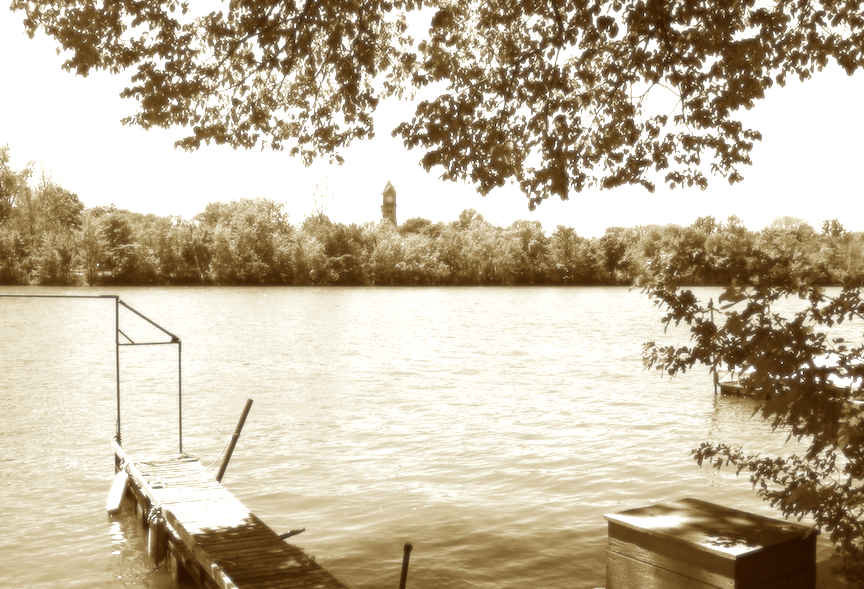
A block from our house was the slow, brown Kankakee River, the banks lined with Oaks and Maples. Riverview Park. On the opposite bank a five-story blond limestone clock tower loomed over the trees. It was the marker for the “looney bin” — Kankakee State Hospital. A dreary castle from a foreign kingdom, housingthe suffering “mentals.” Being sent “across the river” meant you’d “lost your marbles” (certainly not the jokey Allen Kaprow version).
Kankakee State Hospital Clocktower from across the river
In the freezing winter, when ice blanketed the river, one of the deranged might cross over, heading for our neighborhood park. (The fire department would spray the vacant tennis courts in the winter for skating, keeping kids from the dangerous river. If you were out on that ice there was a chance you could break through and be swept under by the current. A boat equipped with outsize fish hooks on long ropes tucked in the fire-station boat, sure caught your eye. It was used to retrieve the bodies drowned under the ice. Every school trip to the firehouse, the “rescue” boat was pointed out, the retrieved dead “felt like a jellied ham” we were told). The icy tennis courts encompassed by chain link, newly sprayed by the fire department, offered descent enough fun. On the icebound court, we found ourselves trapped one day, cornered as in a cage, by a guy in institutional denim wanting to sell us “candy”— what was really a rumpled pack of Chesterfields and matches. With bulging eyes, ice blue, and an extra long incisor dug into his lip, this guy was a storybook nightmare. He finally wandered away leaving us in a mist of terror. He wandered back toward the river, across our park, climbed into a car, leaned onto the horn and was soon gathered up by the white coats. “Just don’t look in his eyes next time —their eyes can make you insane yourself.”
Our Elm Street, a Norman Rockwell Post Magazine cover, had its own brand of havoc swept under the manicured carpets of lawn. Two doors down from us was Art (of the Perfect Lawn) and his wife, who had lost her marbles. In his yard was a prolific tree of pie-cherries and we were allowed to pick if we could endure the shoutied gibberish at phantoms — Art gently leading her back to the house. We’d see her laden with bags of deposit bottles going back to the store covering more distance side to side than forward, shadows of Elm leaves passing over her like in a submerged dream. A bike ride away there was a real “woods”, a woods with straight temple columns of Oak trunks. We’d park our bikes and sneak up a narrow dirt trail to a clearing to spy on the “hermit” living in a tiny cinderblock house — smoke always pouring from a stovepipe. Rarely, you’d see him out of his shack hacking away at his garden with a hoe. There was Doctor, wife and two kids, Jewish refugees from the Nazi chaos who built a Bauhaus-inspired safe-harbor — a blond brick fortress with a creeping bent lawn, golf green smooth, requiring a special lawn mower to maintain the precision. Both the Doctor’s children were musical prodigies, brilliant and a wonder to us. How did that complexof notes on a staff translate to the magic we heard? Mystery. In a horrifying accident, the daughter fell into the rattling lawn contraption, cutting her hands badly, snuffing a promising career on the concert stage.
A notorious pair of dogs prowled the neighborhood, hunting for squirrels, always coming up empty, until one day they happened on an escaped pet bunny. Pieces of the hapless rag of a thing went flying as they tore it to bits. Theterrors of the fairy tale were right at hand. You poked an opossum by the road to see if it really was playing dead. Poke poke poke and it erupted with a boiling fester of maggots.
While our parents were enraptured by Vladimir Ashkenazi or maybe Tosca, eating Steak Diane at Fritzel’s, we were in the thrall of The Snow Queen: a journey towards love, betrayal, longing, revenge. Supernatural beings, injustice, captivity and heroic rescue served up — in the casual peace of bedtime. Our dinner was prepared á la Leuth — hamburgers with ketchup mixed in before cooking. The beef mixed with the sugar in the ketchup would fry up to make a crispy crust. I still make hamburgers this way. She hated the TV and occupied us with games. Before our story time we played Sorry and Monopoly but mostly card games. She knew the meanings of the cards in a regulation deck and could tell fortunes systematically laying out the cards in a cross shape. I’m remembering her reporting that December 7 (my birthday) meant that I was a Jack of Spades, the memory master.
We knew she had magical powers and unbeknownst to our parents she had practiced as a professional medium telling fortunes, plus psychic counseling to bump her meager teacher salary. One night she practiced on my brother and me, when we had a fourth for a card-table seance — a neighbor, Ricky Wurtzel was over — with all the lights off she put a candle in the middle of the table and we imagined our dead great-grandmother (“can you think of anyone who’s passed away recently?”) appearing as a glowing shadow. We all put our hands palm down on the table and chanted in unison up table up, rise table rise, rise table rise. It rose. It really rose!
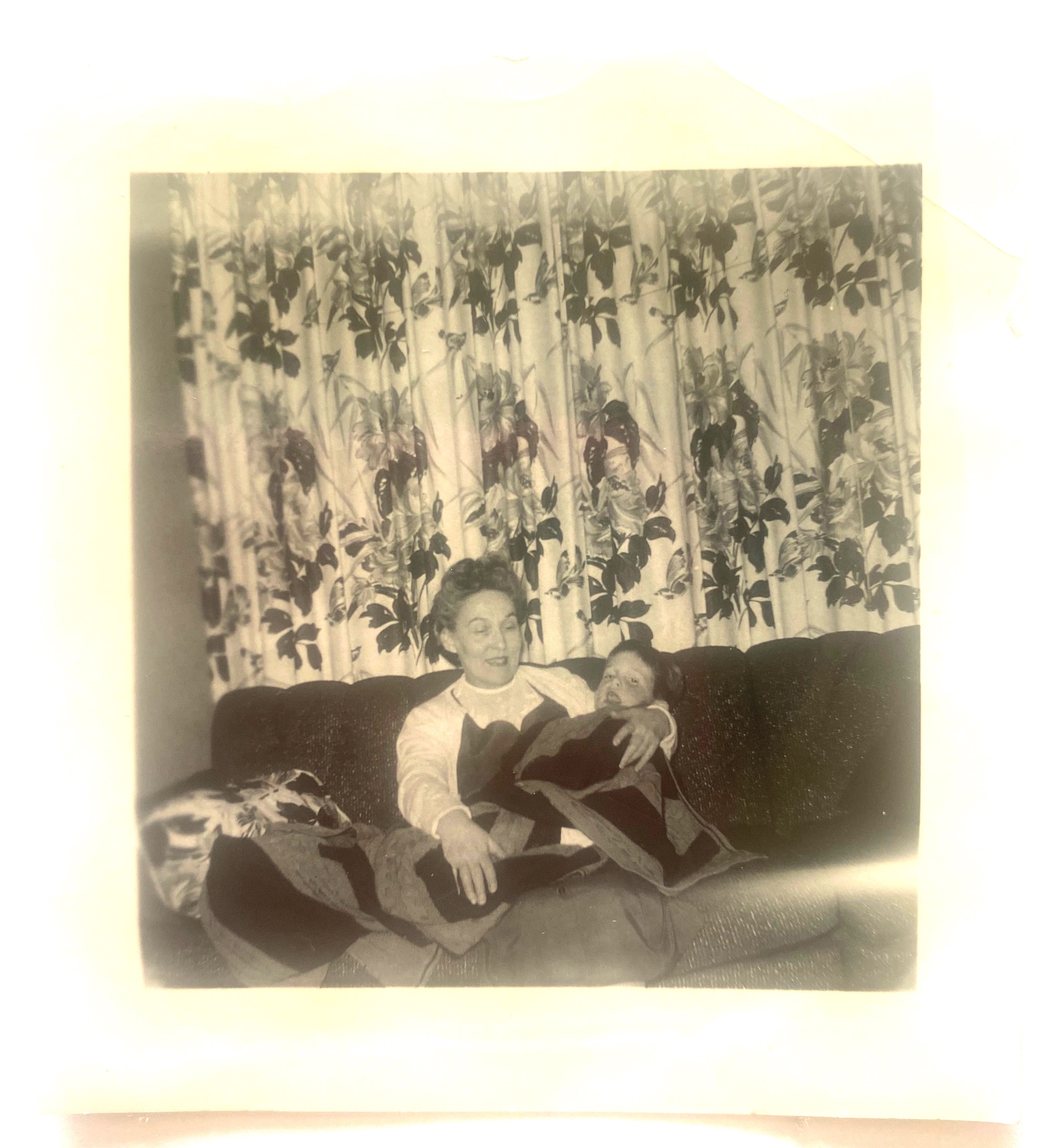
Great Grandmother Ella Greenberg
Some kind of Houdini parlor trick to be sure, and it could have knocked our young minds off base if it weren’t for the balm of her relaxed power. We were in the arms of protection, we could face the ghosty-thin beings her seance brought into our living room. Think of the nightmare spirit-world shapes by Giacometti — when I saw his retrospective (1965) I recognized them as a brilliant retrieval of beings from the other world we’d seen in the seance. Poor Ricky Wurtzel, though, didn’t feel the protection of Mrs. Leuth and whined to his folks that Mrs. Leuth was a witch. The next evening Mrs Leuth was a goner—so sad, no amount of wheedling, none of our promissory skills (we’ll do anything…) could make her return. I don’t have a recollection of what our mother said, but I can still see her earnest face leaning in to give us the sad news. The amazing Mrs. Leuth was replaced by a series of dull, chubby girls worried about their skin, from Olivet Nazarene College, uninterested in story time.
<><><><><>
A few years after the seance, I filled in on a sick buddies’ paper route… Ding-dong!… “Collecting for The Journal….” My skin shrank two sizes too small. “Mrs. Leuth!” She seemed not to know me, that horizon-line-across-the-river stare, looking straight through my skin!
Kids don’t need much of a push to evoke the mysterious, gawking wonder of the loosed imagination. These days, half a century later, it’s taking less and less time for me to unstick from mental gravity. 50 years of indulgant imagination in my studio, making pictures, has pretty much permanently pulled aside the curtains hiding the inner life. For me, Mrs. Leuth is ready and waiting, still there, commander of the creation rocket, ready to launch…
Fifty years, and I can bring the wonder we feIt, right into my chest — a nervous tightness and a flock of birds rising all at once. It makes me think of the Mrs. Leuth era as a kind of Fanny and Alexander magic time, when we were’t very far removed the Golden-Child Age, when animals could talk and strange beings lived in the patterns of the woodwork. It was clear the imagination she evoked in the stories needed her brand of generosity — a proper, formal sort of kindness. The thought of our sad, forced graduation from the embrace of story-telling fills me with with the longing I feel, the compulsion, really, to finish my own work of story telling in my studio. I often feel like I did then, dreaming of a world empty of us, as if I am standing on the edge of a wilderness mountain lake, far away from everything and anything except itself. Hey, guess what?…
It may have taken a village but, in this case, there was an unexpected and unfortunate mis-interpretation. When Hilary Clinton was writingIt Takes A Village (1996) she asked Jean Houston for help. Houston, as scholar, philosopher, researcher and one of the prime-founders of the Human Potential Movement has written some 26 books.
So who better than Houston to help Clinton realize her creative potential and write her vision of the importance of community? And who could best guide and help to imagine: What would Ghandi say? What would Eleanor Roosevelt say? Good questions when trying to gain wisdom from the voices of the past. Regrettably, this meeting of the minds was made into an incident that was spun into “seance” with Clinton speaking with the dead and Houston dubbed as the “First Lady’s Spiritual Advisor.”
Although Houston was not Clinton’s spiritual advisor she certainly was mine. With a steady hand and a guiding light she was with me in spirit as I explored and experienced altered and expanded states of consciousness with and without drugs.
Jean Houston, with her husband Robert Masters, was founder/co-director of the Foundation for Mind Research. In 1972 they co-wrote Mind Games — the Guide to Inner Space. It was not the amusement of parlour games, rather mental and spiritual exercises for building an agile and creative mind. For the altered states of consciousness set, sans drugs, it was a book to be read aloud, in a group, with one person taking on the role of “guide” and the other participants listening to inductions, receiving instructions about how to move in and out of trance.
In the spring semester of my senior year in college (1972) a friend proposed Mind Games as an independent study course. She needed to convene a group of trustworthy players willing to suspend judgement and open themselves to new ways of thinking. Since a quiet place, free of distractions was necessary, the circle of eight of us met most times at my house.
Each session takes one deeper and deeper into a state of focused attention, a “hypnotic” state of mind, a place with enhanced ability to concentrate then, gently takes one safely back to “reality”, returning with a renewed sense of being.
Find yourself a quiet, comfortable place, free of distractions where you can stretch out, relaxing as fully as you can; discovering that you can relax even a bit more. Then click the play button on this audio file and attend to the sound of my voice.
It is my hope that you will emerge from this experience refreshed, enriched and deepened so that you now can go farther on your way, without my audio prompt, knowing that you can return again and again to this tranquil place — stepping down the ancient stone staircase, finding the small boat at the edge of the dark water, drifting deeper and deeper until you arrive at the meadow where you will feel in total harmony with all things. In that mentally enhanced state, you can enjoy listening to music, contemplate the beauty of an artwork, or envision solutions to problems.
The benefits of this inner travel are many. And, especially these days, when we can’t go anywhere any way. As much as we might be longing to travel the world, we can instead appreciate the adventure that awaits just inside our heads.
Even John Lennon was a fan of Mind Games and produced an record album with lyrics expressing his philosophy of peace and love. He wanted people to continue planting the seeds of this ideal with “faith in the future, outta the now.”









 ——Art—Spirit—Now——